
Most of the red flags when hiring a bookkeeper turn up in the very first conversation, and most owners walk straight past them. Not because the signs are subtle. Because the person across the table is friendly, the price is good, and every answer arrives with confidence.
Confidence isn't the problem. We see how it ends when a file lands on our desk for cleanup two years later, and the warning signs were almost always audible on day one.
Nine of them are worth memorising. Here's what each one sounds like, and what it costs you when you let it slide.
The nine red flags when hiring a bookkeeper
1. You won't be the admin on your own accounting file
Ask early whose name the QuickBooks Online or Xero subscription sits in. The right answer is yours, with the bookkeeper added as a user you could remove in thirty seconds.
The wrong answer sounds helpful. "We keep all our clients on our firm subscription — it's simpler, and it saves you the monthly fee." It is simpler. For them.
Your ledger, your receipts and your entire audit trail then live inside an account you don't control. Relationships end. When this one does, you'll be negotiating for your own records with someone who has stopped returning calls. CRA expects you to produce six years of books on request, and "my last bookkeeper has them" isn't a defence. You saved a subscription fee and bought a very expensive year.
2. No straight answer about what happens if you leave
Related, and worse, because it tells you about intent rather than habit. Ask it plainly: if we part ways in eighteen months, what do I get, in what format, and how long does it take?
A practice that has done this before answers in one breath. You get the file, you get the working papers, and there's a handover call with whoever comes next.
Hesitation is the answer. So is a joke about not planning to lose you, and so is a monthly fee that quietly includes something called data hosting.
3. "We'll just net it out"
The most useful thing you can probe is what happens to a transaction nobody can identify. A $4,200 deposit, no invoice, no note.
A good bookkeeper asks you about it — every month, in a short list, and they'll chase you until you answer. A weak one plugs it somewhere plausible and moves on, because the ledger balances either way and you were never going to look.
What that costs you is reconciliations that were never real. Your accountant finds it at year end, bills hours to unwind it, and files late. If those books supported a loan application or a shareholder draw in the meantime, they were fiction.
Ask which accounts get reconciled monthly. If the answer is the chequing account and nothing else, your credit cards, loans and HST control account are all quietly drifting.
4. Sales tax filed off the bank balance
This is the most expensive habit in Canadian small-business bookkeeping, and it's everywhere.
The pattern: HST gets remitted based on whatever looks like sales in the bank, input tax credits get estimated, and nobody checks whether the supplies were taxable, zero-rated or exempt. It survives for years because CRA doesn't review most returns.
Then a letter arrives, and several years get recalculated at once with interest running. Under-claimed ITCs are money you simply never got back. Over-claimed ones come back as an assessment.
Ask how they arrive at line 105 and line 108 of a GST/HST return. If the answer isn't "from the sales tax report in the ledger, after the accounts are reconciled," it's guesswork with a filing deadline attached. Our HST and GST filing guide sets out what the process should actually look like.
5. Reports arrive "when they're ready"
Ask what date your financial statements land each month. Not how fast they work. The date.
Vagueness here means there's no close process. The month ends, and the books get touched when someone has a gap in their week. In cleanup files it also tends to mean nothing happened between January and April, because the same person was buried in tax work for other clients.
So you make decisions on numbers that are six or eight weeks old, which is a longer way of saying you make decisions on your bank balance. A defined monthly close is most of what you're paying for. What a monthly close includes is worth reading before the meeting, so you can tell whether the answer you get is real.
6. Ask My Accountant is doing the heavy lifting
If you're taking over an existing file, open the suspense account — QuickBooks calls it Ask My Accountant. It's where uncategorized transactions wait for a question that never gets asked.
A few hundred dollars sitting there mid-month is normal housekeeping. Five figures, or a balance that grows every month and never clears, tells you someone has been coding what's easy and parking what isn't.
Hiring rather than inheriting, the same principle applies: ask how they handle transactions they can't categorize, and how you'll hear about them. "A question list goes out with the monthly reports" is a process. "We'll sort it at year end" is a backlog with a deadline.
7. A firm quote before anyone looked at your file
Nobody can price a file they haven't seen. Transaction volume, how many bank and card accounts you run, whether you're registered for HST, how far behind you are, whether there's inventory or foreign currency — that's what decides the work.
A number offered before any of that is either a number that will change, or a number chosen to win the job and recovered later through extras.
The reverse is a genuinely good sign. A bookkeeper who asks for three months of bank statements before quoting is already doing the job. We work the same way, and our pricing page sets out what the flat monthly rates cover.
8. No engagement letter
Bookkeeping isn't regulated in Canada. There's no licensing body, no complaints process, no professional order to write to. The engagement letter is the only enforceable description of what you agreed to.
It should cover what's included, what's excluded, the monthly fee, how catch-up work is priced separately, who owns the file, and notice periods on both sides. A page and a half is plenty.
"We don't really do contracts, we work on trust" isn't warmth. It's the answer that makes the first disagreement unwinnable.
9. One person, no backup, no insurance
Solo bookkeepers do excellent work. Several of the best we've worked alongside run one-person practices, so this isn't an argument against them.
The question is what happens during the two weeks they're in hospital, or the month they take off in July. Your HST deadline doesn't move for either.
Ask two things: who covers the file when you're away, and do you carry errors and omissions insurance? E&O isn't mandatory for bookkeepers here, which is exactly why the answer is informative. An established practice carries it and will send the certificate without being asked twice.
The nine at a glance
| Red flag | What you'll hear | What it costs later |
|---|---|---|
| Not the admin on your file | "We keep it on our subscription" | Records held hostage, six-year CRA exposure |
| No exit answer | "Let's not think about that" | Weeks of delay and a rebuilt ledger |
| Unknowns get plugged | "We'll just net it out" | Reconciliations that were never real |
| Sales tax off the bank | "We estimate the ITCs" | Reassessment plus interest, lost credits |
| No reporting date | "When they're ready" | Decisions made on stale numbers |
| Suspense account growing | "We'll sort it at year end" | Year-end bill and a late filing |
| Quote before review | A firm price, no questions | Scope creep and surprise extras |
| No engagement letter | "We work on trust" | No recourse when scope is disputed |
| No backup or E&O cover | "I handle everything myself" | Missed deadlines when life happens |
What is not a red flag when hiring a bookkeeper
Half the owners who call us are worried about the wrong signals, so it's worth saying which ones are noise.
Not being a CPA. Bookkeeping and accounting are different jobs. Your bookkeeper maintains the ledger and files sales tax; your accountant handles year-end and tax planning. The split between the two roles explains where one hands off to the other.
No certification. CPB Canada membership is voluntary and worth something, but plenty of excellent bookkeepers hold none. Verified experience on files like yours beats a designation on a website.
Not being local. Bank feeds, CRA filings and monthly reporting are all electronic now. Location matters if you handle cash daily or hold paper you can't scan. Otherwise it's a preference, not a standard.
A team rather than one person. A preparer and a reviewer on the same file is a control, not a dilution — as long as you know who to email.
Raising the quote after seeing the books. If the price moves once they've counted 800 transactions a month instead of the 200 you guessed, that's honest scoping. Judge the explanation, not the direction.
Where to start
Do the cheap checks before you sit down. Search the name alongside your city, confirm any credential in the issuing body's own directory rather than on the bookkeeper's about page, and read how to choose a bookkeeping service so you know what you're weighing. If you're still building a shortlist, the six places worth looking covers sourcing.
Then run the conversation properly. Our questions to ask a bookkeeper before hiring is the full sit-down script — the nine flags above are what you're listening for while they answer.
And if you're reading this because the last one already went wrong, the fix is usually a scoped cleanup rather than starting over. Catch-up bookkeeping covers how far back it typically goes and what drives the cost, and our catch-up service rebuilds the reconciliations and the sales tax position from source documents. Tell us what state the books are in and we'll scope what it takes to get them CRA-Ready.
Frequently Asked Questions
See the work before you buy it
This is what lands in your inbox by the 10th.
A 11-page management package and the matching Excel workbook — your P&L against industry targets, EBITDA with owner-pay scenarios, and a cash flow written in sentences. Read the real thing, page by page.
See the full package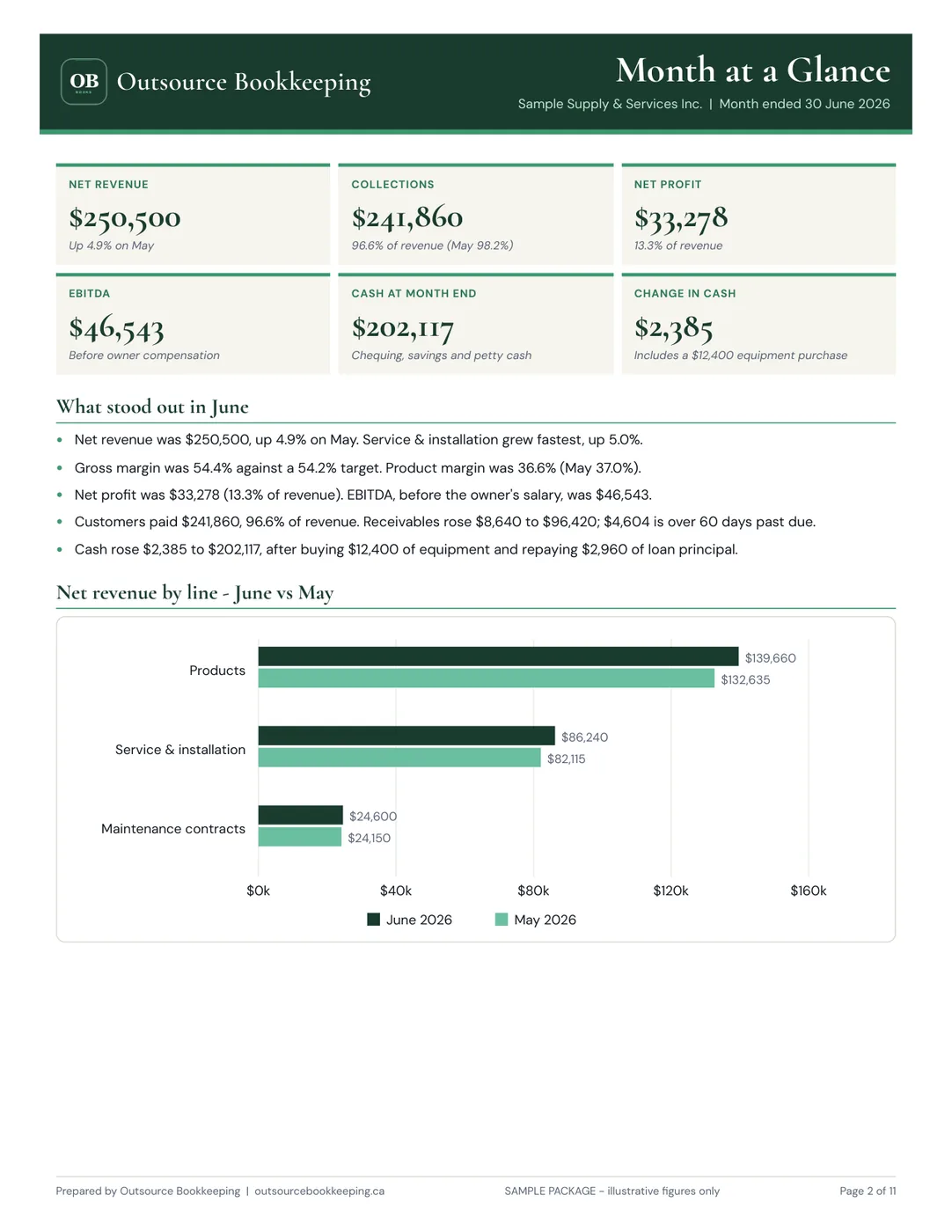
Need professional bookkeeping?
Outsource Bookkeeping delivers CRA-ready financial reports by the 10th of every month — flat rate, no surprises. See our pricing →
