
The Difference Between a Bookkeeper and an Accountant
If you run a small business in Canada, you've probably used the terms "bookkeeper" and "accountant" interchangeably. Most people do. But they're actually very different professionals with very different roles — and understanding the difference can save you significant money and help you build the right financial team.
The short version: a bookkeeper records what happened; an accountant interprets and acts on it.
What Does a Bookkeeper Do?
A bookkeeper manages your day-to-day financial records. Their job is to keep your books accurate, current, and organized throughout the year. Specifically, a bookkeeper:
- ●Records all transactions — every sale, purchase, expense, and payment is entered into your accounting software (QuickBooks, Xero)
- ●Categorizes expenses — each transaction is assigned to the correct account (office supplies, equipment, advertising, cost of goods sold, etc.)
- ●Reconciles bank accounts — your bank statements are matched against your accounting records every month to catch errors and confirm accuracy
- ●Manages accounts payable/receivable — tracks what you owe to vendors and what customers owe you
- ●Prepares HST/GST returns — calculates the HST owing (or refund) and prepares the return for filing with CRA
- ●Produces monthly financial statements — Profit & Loss, Balance Sheet, and Cash Flow Statement delivered on a set schedule
Bookkeepers work year-round to keep your financial data current. Their output — accurate, reconciled books — is what makes everything else in your business's financial life possible.
What bookkeepers don't do: - File corporate or personal income tax returns - Provide tax strategy or planning advice - Handle complex transactions (mergers, acquisitions, complex reorganizations) - Provide audit services - Give investment advice
What Does an Accountant Do?
In Canada, the accounting designation is Chartered Professional Accountant. Chartered Professional Accountants are licensed professionals who can perform services bookkeepers cannot:
- ●File corporate and personal income tax returns — T2 (corporate) and T1 (personal) returns require an accountant for accuracy and liability
- ●Tax planning and optimization — accountants identify legal strategies to minimize your tax burden (salary vs. dividend decisions, RRSP contributions, capital gains planning)
- ●Financial statement audits and reviews — required by investors, lenders, or regulatory bodies
- ●Business structuring — advice on incorporation, holding companies, and corporate reorganizations
- ●CRA disputes and audits — representing you if CRA audits your business
- ●Financial advisory — cash flow forecasting, business valuation, mergers and acquisitions advice
Accountants in Canada charge $150–$400/hour, reflecting their advanced training and professional liability.
The Relationship Between Bookkeeping and Accounting
Bookkeeping and accounting exist on a financial services continuum:
| Service | Who Provides It | Timing | Typical Cost |
|---|---|---|---|
| Transaction recording | Bookkeeper | Ongoing (monthly) | $350–$800/month |
| Bank reconciliation | Bookkeeper | Monthly | Included in above |
| HST/GST filing | Bookkeeper | Quarterly or monthly | Included or +$100–$200/return |
| Monthly financial statements | Bookkeeper | Monthly | Included in above |
| Year-end bookkeeping prep | Bookkeeper | Annually | Included or +$300–$600 |
| Corporate tax return (T2) | Accountant | Annually | $1,500–$5,000 |
| Tax planning | Accountant | As needed | $200–$400/hour |
| Audit/review engagement | Accountant | As needed | $3,000–$15,000+ |
The key insight: Clean, accurate books maintained by a professional bookkeeper reduce the time your accountant spends at year-end — dramatically lowering your total accounting bill.
An accountant who receives disorganized books spends billable hours cleaning them up before they can even start your tax return. That cleanup at $300/hour is far more expensive than the $500/month that would have maintained the books properly throughout the year.
When You Need a Bookkeeper
Hire a bookkeeper (or a bookkeeping service) when: - Your business has more than 20–30 transactions per month - You are registered for HST/GST and need regular filings - You want accurate monthly financial data to manage your business - You're spending more than 3–4 hours per month on financial admin - Your accountant has told you your books are disorganized
When You Need an Accountant
Hire an accountant when: - You need to file a corporate tax return (T2) - You want tax planning advice (salary vs. dividends, RRSP, etc.) - You're raising investment or applying for a bank loan (financial review or audit) - CRA has contacted you for an audit or has questions about your return - You're considering incorporating, acquiring another business, or selling your company
Do I Need Both?
Yes — for most incorporated Canadian businesses, you need both.
The typical setup for a Canadian small business: 1. Monthly bookkeeping service (like Outsource Bookkeeping): handles all ongoing financial records, HST/GST filing, and monthly reports at a flat monthly fee 2. Accountant engagement (annually): uses your clean year-end books to file your T2 corporate return and provide tax planning advice
This combination gives you the best of both worlds: accurate, current financial data year-round, plus professional tax compliance and advice.
The Bottom Line
Bookkeepers and accountants are partners, not substitutes. For a growing Canadian small business, the most cost-effective structure is a professional bookkeeping service managing your monthly records, paired with an accountant for annual tax filing and strategic advice.
At Outsource Bookkeeping, we work seamlessly with your existing accountant — delivering CRA-ready financial statements by the 10th of every month so your accountant has everything they need for a fast, accurate year-end engagement.
Frequently Asked Questions
See the work before you buy it
This is what lands in your inbox by the 10th.
A 11-page management package and the matching Excel workbook — your P&L against industry targets, EBITDA with owner-pay scenarios, and a cash flow written in sentences. Read the real thing, page by page.
See the full package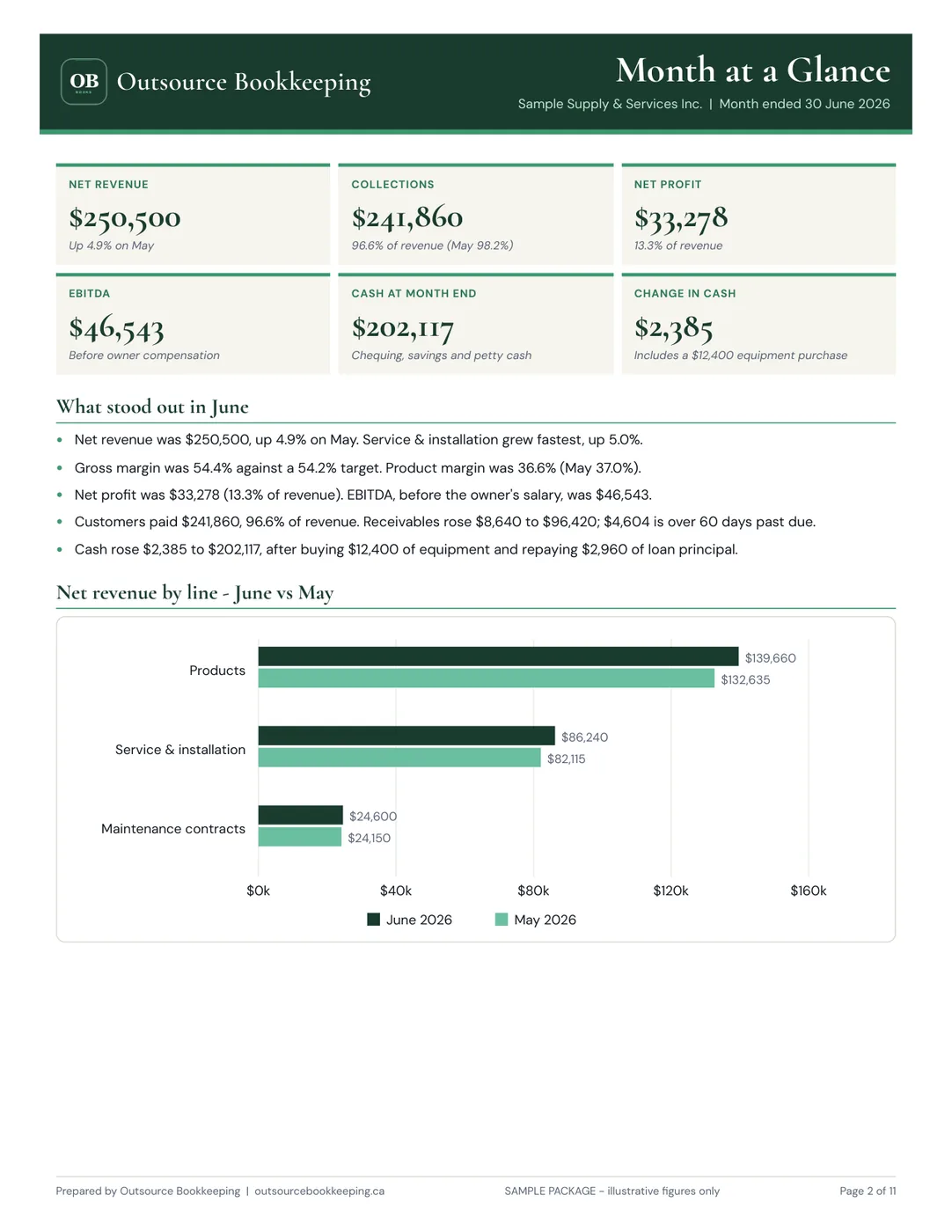
Need professional bookkeeping?
Outsource Bookkeeping delivers CRA-ready financial reports by the 10th of every month — flat rate, no surprises. See our pricing →
