
What is bookkeeping?
Bookkeeping is the systematic recording, organizing, and maintaining of a business's financial transactions. Every sale, purchase, payment, and receipt is recorded in an organized way so that business owners, accountants, and the CRA can understand the financial position of the business at any point in time.
Bookkeeping is not accounting. Accounting (done by an accountant) involves tax planning, compliance strategy, and financial analysis. Bookkeeping is the foundation that makes accounting possible.
What does a bookkeeper actually do?
1. Transaction Recording and Categorization
Every financial transaction — sales invoices, bills, expenses, payroll — needs to be recorded in your accounting software (QuickBooks, Xero). A bookkeeper ensures every transaction is categorized correctly to the right account (office supplies vs. equipment, advertising vs. meals, etc.).
Incorrect categorization leads to inaccurate financial statements and potential CRA audit triggers.
2. Bank and Credit Card Reconciliation
Monthly reconciliation compares your bank statement against your accounting records to ensure they match exactly. This process catches errors, identifies missing transactions, and confirms the accuracy of your books.
A business that never reconciles its accounts often discovers discrepancies at year-end — sometimes years after they occurred, when they're difficult or impossible to fix.
3. Accounts Payable and Receivable Management
- ●Accounts Payable (AP): Tracking bills you owe to suppliers and vendors. A bookkeeper ensures your bills are recorded and paid on time.
- ●Accounts Receivable (AR): Tracking money your customers owe you. A bookkeeper follows up on overdue invoices and applies payments when received.
Poor AR management is one of the top causes of cash flow problems in small businesses.
4. HST/GST Filing Preparation
A bookkeeper tracks all taxable and exempt revenues, as well as all Input Tax Credits (ITCs) on purchases. This data is used to prepare your HST/GST return, which must be filed with CRA quarterly or annually.
5. Payroll Recording
If you have employees, payroll transactions (wages, source deductions, employer contributions) must be recorded in your books. A bookkeeper records payroll entries and reconciles payroll remittances to CRA.
6. Financial Report Preparation
Every month, a bookkeeper closes the books and prepares: - Profit & Loss Statement — revenue, expenses, and net income - Balance Sheet — assets, liabilities, and equity - Cash Flow Statement — where cash came from and went
These reports are the foundation of every business decision you make — and what your accountant needs to do their job.
7. Year-End Preparation
At year-end, a bookkeeper prepares a complete, clean set of financials for your accountant. This includes a trial balance, all supporting schedules, and a review of all accounts to ensure accuracy.
Clean year-end books can save you hundreds of dollars in accounting fees.
What a bookkeeper does NOT do
Bookkeepers do not file corporate or personal income tax returns (that's an accountant's job). They do not give financial advice or tax strategy. They focus exclusively on accurate record-keeping and reporting.
The cost of not having a bookkeeper
Without a bookkeeper, most small business owners face: - Year-end chaos — scrambling to find receipts and organize a year's worth of transactions - CRA penalties — for late or inaccurate HST/GST filings - High accounting fees — accountants charge $150–$400/hour to clean up messy books - Poor financial decisions — made without accurate data
A professional bookkeeping service typically costs $350–$500/month — far less than the cost of errors, penalties, and accountant cleanup fees.
How Outsource Bookkeeping works
We provide flat-rate monthly bookkeeping at from $500/month for Canadian businesses of all sizes. We handle all of the above — delivering CRA-ready financial reports to your inbox by the 10th of every month.
Book a free 15-minute call to learn how we can take your bookkeeping completely off your plate.
Frequently Asked Questions
See the work before you buy it
This is what lands in your inbox by the 10th.
A 11-page management package and the matching Excel workbook — your P&L against industry targets, EBITDA with owner-pay scenarios, and a cash flow written in sentences. Read the real thing, page by page.
See the full package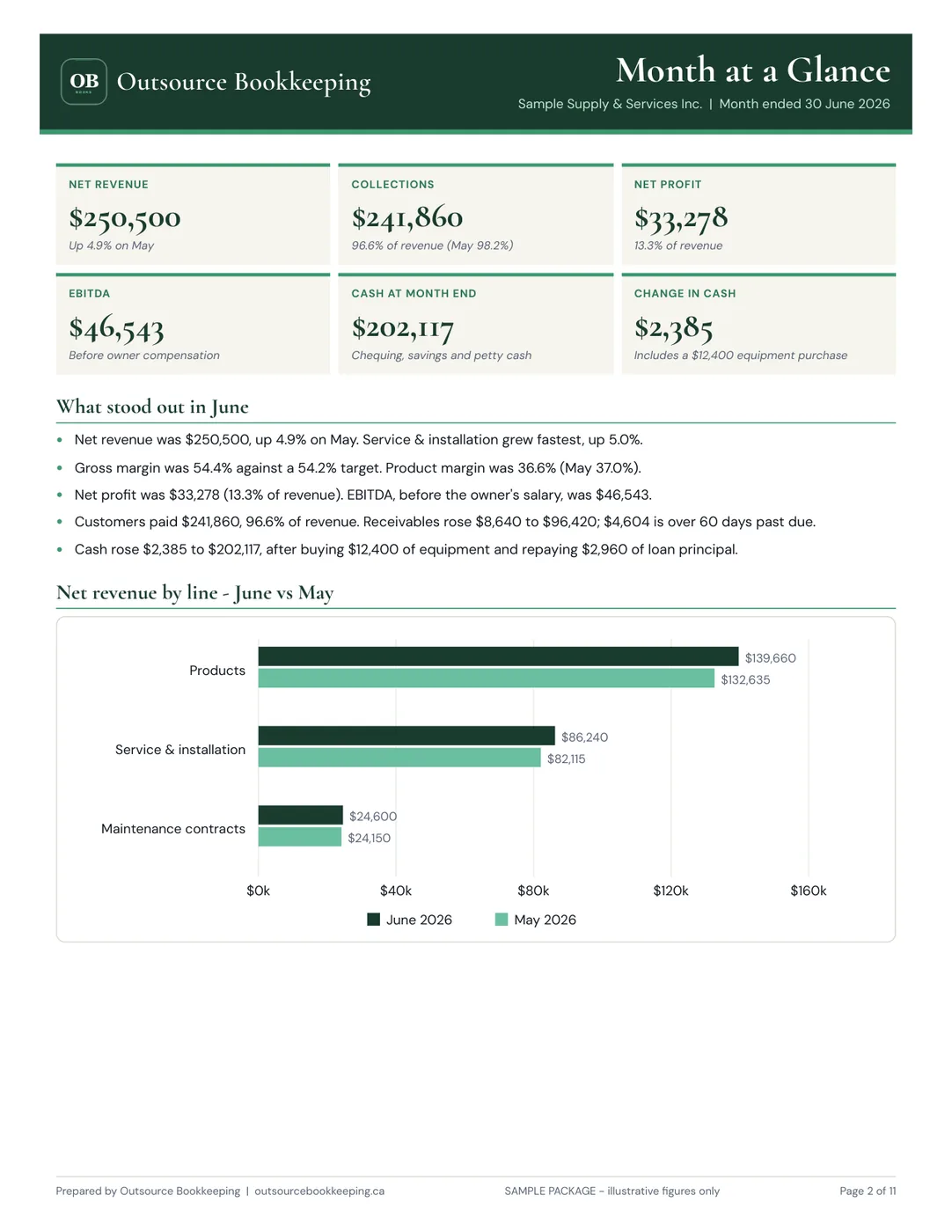
Need professional bookkeeping?
Outsource Bookkeeping delivers CRA-ready financial reports by the 10th of every month — flat rate, no surprises. See our pricing →
