
Why Construction Bookkeeping is Uniquely Challenging
Construction is one of the most financially complex industries for small business owners. Unlike a retail store where every sale is simple and immediate, a construction company deals with: - Projects spanning weeks, months, or years - Costs that arrive before the revenue - Subcontractors, materials, equipment, and overhead all intermingled - Progress billing and holdbacks - CRA Source Deductions for employees - HST on both revenues and purchases
Without proper bookkeeping — specifically job costing — most construction businesses have no idea which projects are making money and which are quietly destroying their margins.
What is Job Costing?
Job costing is the practice of tracking every dollar of revenue and every dollar of cost against a specific project or job number. Instead of one big revenue account and one big expense account, you have:
- ●Job #1001 — Smith Renovation: $85,000 revenue | $62,000 costs | $23,000 gross profit
- ●Job #1002 — Office Buildout: $210,000 revenue | $185,000 costs | $25,000 gross profit
- ●Job #1003 — Basement Waterproofing: $15,000 revenue | $14,500 costs | $500 gross profit
Suddenly you can see that Job #1003 was nearly breakeven — and should have been priced 15% higher. Without job costing, this information is invisible until year-end.
Setting Up Job Costing in QuickBooks Online
Most construction businesses use QuickBooks Online or Xero. Proper job costing setup involves:
1. Create Customers/Jobs Each project gets set up as a sub-customer or project in QuickBooks. All invoices and payments are assigned to the correct project.
2. Use Classes or Projects for Costs When entering bills, credit card charges, and payroll costs, assign each to the correct project. This is where most construction businesses fail — inconsistent cost assignment makes job reports useless.
3. Track Cost Categories by Job For each project, track costs by category: - **Direct labour:** On-site wages and subcontractor payments - **Materials:** Lumber, hardware, concrete, fixtures - **Equipment:** Rentals, depreciation, fuel - **Subcontractors:** Payments to subtrades (electricians, plumbers, drywall) - **Permits and fees:** Municipal permits, inspection fees - **Other direct costs:** Blueprints, surveying, etc.
4. Run Job Profitability Reports Monthly job profitability reports compare budgeted vs. actual costs for each active project — and show whether you're on track to meet your margin target.
Progress Billing and Holdbacks
Construction projects often use progress billing — invoicing clients for the percentage of work completed rather than waiting until the job is done. This requires: - Tracking the contract value for each job - Calculating the percentage complete monthly - Issuing progress invoices accordingly - Recording holdbacks (10% of each progress claim, typically) as a liability until project completion
Holdbacks are one of the most commonly mishandled items in construction bookkeeping. The holdback belongs to your client until released — it should not be recorded as revenue until you're entitled to it.
Subcontractor Management and T5018 Slips
If your construction company pays subcontractors more than $500 per calendar year, you must file a T5018 slip with CRA (Statement of Contract Payments). This applies to: - Subtrades paid by invoice - Owner-operators of construction firms - Any individual or business receiving payment for construction services
T5018s are due by the last day of February following the calendar year (or 6 months after your fiscal year-end for non-calendar year-end filers). Missing T5018 filings triggers CRA penalties.
Your bookkeeper maintains a subcontractor registry and prepares T5018 slips annually.
Employee vs. Subcontractor Classification
The CRA scrutinizes the construction industry closely for employee vs. subcontractor misclassification. Workers who appear to be employees (working exclusively for you, using your tools, working set hours) but are paid as subcontractors represent a major liability.
If CRA determines your subcontractors are actually employees, you become responsible for: - Unremitted CPP contributions (employer + employee share) - Unremitted EI premiums (employer + employee share) - Interest and penalties on late remittances
This can be a business-threatening assessment. A bookkeeper with construction experience flags misclassification risks before they become CRA problems.
HST in Construction
Construction is almost entirely HST-taxable. You must: - Charge HST on all invoices to clients (13% in Ontario) - Collect HST from clients on progress billings - Claim ITCs on all materials, subcontractors, equipment, and overhead purchases - File HST returns quarterly (most mid-size contractors) or annually (small contractors) - Track HST on the holdback separately — holdback HST is typically claimed when the holdback is released
Seasonal Cash Flow Management
Construction is highly seasonal in most Canadian markets. A bookkeeper helps you: - Build monthly cash flow projections based on active jobs - Identify gaps between when costs are incurred and when invoices are collected - Maintain adequate HST reserves for quarterly remittances - Plan for slow seasons (winter in most of Canada)
How Outsource Bookkeeping Serves Construction Companies
We provide specialized bookkeeping for general contractors, specialty trades, renovation companies, and property developers across Canada. We set up proper job costing in QuickBooks Online, track subcontractor payments, prepare T5018 slips, and deliver monthly job profitability reports alongside your standard financial statements.
Book a free consultation to see how proper construction bookkeeping can improve your margins.
Frequently Asked Questions
See the work before you buy it
This is what lands in your inbox by the 10th.
A 11-page management package and the matching Excel workbook — your P&L against industry targets, EBITDA with owner-pay scenarios, and a cash flow written in sentences. Read the real thing, page by page.
See the full package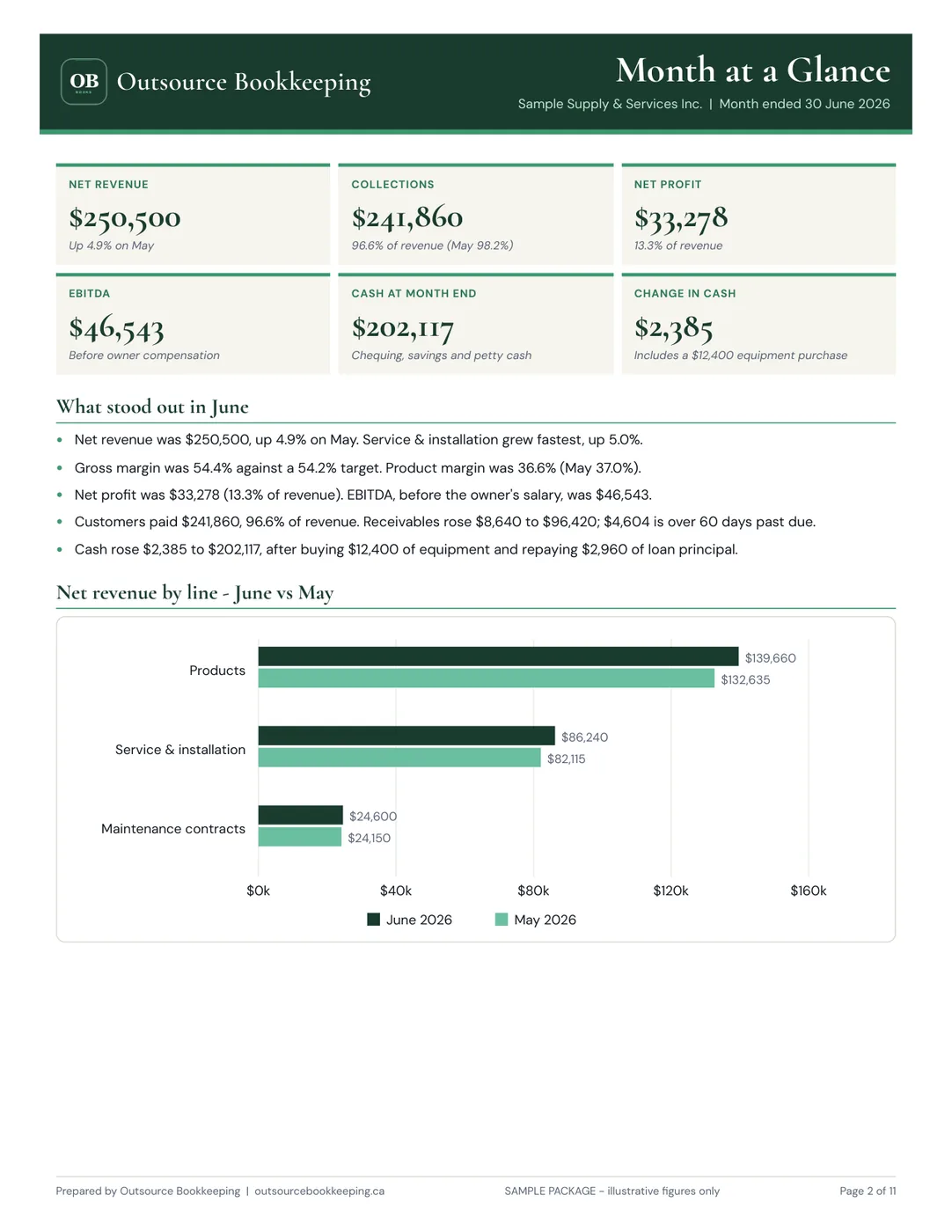
Need professional bookkeeping?
Outsource Bookkeeping delivers CRA-ready financial reports by the 10th of every month — flat rate, no surprises. See our pricing →
