
Most small business owners searching for a part-time bookkeeper in Canada picture the same thing: someone who comes in a couple of days a week, does the books, and leaves. That person exists. They're just rarely the right answer at the size most businesses actually are, and rarely worth what they cost.
Here's what we tell owners on the first call. A business running 80 transactions a month doesn't need a part-time bookkeeper — it needs a few hours of bookkeeping, which is a different purchase. Below are the three real ways to buy those hours, what each costs in Canadian dollars, and where each one quietly falls apart.
What a part-time bookkeeper in Canada actually means
Almost nobody needs a bookkeeper sitting at a desk 20 hours a week. A typical small business — a trades company, a clinic, a consultancy under $2M in revenue — needs somewhere between 3 and 15 hours of bookkeeping a month. Not a week. A month.
So when owners say "part-time," they usually mean flexible: pay for the work the books actually require, not for a seat. Once you frame it that way, the decision isn't full-time versus part-time. It's which delivery model gets you those hours reliably, at a price that makes sense. There are three.
Option 1: The hourly freelance bookkeeper
A freelancer bills you by the hour, or by the month, for the time your file takes. In Canada that runs roughly $30 to $75 an hour depending on experience and city. For a simple sole proprietor, five hours a month at $50 is $250 — genuinely part-time, genuinely affordable.
Freelancers work well when your volume is low and stable and your books are already clean. Where they get thin is coverage. One person means one point of failure. When they take August off, get sick, or land a bigger client and quietly deprioritize yours, your monthly close slips and there's nobody behind them. There's also no reviewer — whatever they book is what lands, right or wrong. We cover the going rates in bookkeeping rates in Canada.
Option 2: The part-time employee on payroll
This is the literal reading — someone on your payroll for, say, 15 hours a week. It's the most expensive option by a wide margin, and it's the one owners underestimate most.
The wage is the smallest part. The moment you put someone on payroll you owe CPP and EI on their earnings, vacation pay at 4% minimum, and you inherit the admin: source deduction remittances to the CRA, a T4 in February, and the cost of finding a replacement when they leave. A part-time bookkeeper at $28 an hour for 15 hours a week isn't costing you $1,800 a month. Loaded, it's closer to $2,300 to $2,600 once CPP, EI, and vacation pay are in.
And you pay for those hours whether the work fills them or not. A light February costs exactly the same as a frantic December. We ran the full math in in-house vs. outsourced bookkeeping, and the loaded number surprises most people.
Option 3: The flat-rate monthly service
This is what most owners actually want when they say part-time — they just don't have the word for it. A flat-rate service charges a fixed monthly fee for a defined scope, regardless of hours. You're buying the outcome: books closed, HST filed, reports in your inbox by a date. Not a timesheet.
For most small businesses this lands between $350 and $600 a month, all in. It beats a freelancer on reliability because of structure — there's a team on the file, so a sick day doesn't stop your close, and a second person typically reviews the work before it goes out. It beats an employee on price because you're not carrying payroll, benefits, or idle hours. Our own plans start at $500/month on the pricing page, and the monthly bookkeeping packages guide breaks down what a flat scope usually includes.
Part-time bookkeeper vs. fractional bookkeeper
You'll see the word "fractional" used for this third option, and it trips people up. A fractional bookkeeper is just a flat-rate outsourced bookkeeper by another name — someone whose time is split across several clients, so each business pays a fraction of a full seat. The label doesn't change what you get. What matters is the scope and the delivery date, not whether it's marketed as "fractional," "outsourced," or "virtual." Ask what's included and when it's done; ignore the adjective.
What a part-time bookkeeper costs: three options side by side
| Option | Typical monthly cost (CAD) | Best for | Main risk |
|---|---|---|---|
| Hourly freelancer | $200–$800 | Low, stable volume; clean books | No backup, no reviewer |
| Part-time employee | $2,300–$2,600 loaded | High volume needing someone on-site | Payroll cost, idle hours, turnover |
| Flat-rate monthly service | $350–$600 | Most small businesses | Less face-to-face than an employee |
The numbers assume a small business under roughly $2M in revenue. A freelancer looks cheapest on the sticker, and for a very small, very simple file it genuinely can be. The gap closes fast the moment your volume climbs or your books need cleanup before anyone can maintain them.
Where each option breaks down
Every model has a point where it stops working, and knowing yours saves a year of frustration.
The freelancer breaks down on growth and on absence. Add payroll, a second entity, or inventory and a solo freelancer either raises their price or falls behind. The part-time employee breaks down on economics — you're paying full loaded cost for a role that's genuinely part-time, and the idle hours are pure waste. The flat-rate service breaks down when you truly need someone physically in your office every day handling cash, cheques, and vendor calls; at that point you've outgrown part-time bookkeeping and you're hiring a controller.
For most owners reading this, the honest answer is the flat-rate service. That's why "part-time bookkeeper" so often ends up meaning "monthly service" once the numbers are on the table.
How many hours do you actually need?
Before you price anything, count. Pull three months of bank and credit card statements and count the transaction lines per month. Under 50 a month with one bank account and no payroll, you're a light file — a few hours' work, and a freelancer or an entry-level flat-rate plan fits. Between 50 and 200, with HST filing and maybe a card or two, you're in the sweet spot for a flat-rate service. Above that, or with payroll and several accounts, you need a firm with a team, not one person stretched across part-time hours.
That count also tells you whether you've crossed the $30,000 HST registration threshold, which changes the job entirely. Once you're filing HST, guessing the numbers off your bank balance stops being safe.
What part-time hours actually cover
A few hours a month buys you the core, and it's worth being clear on what that is so nobody's surprised. At a light-file scope you should expect every bank and card account reconciled, transactions categorized, HST tracked and filed on schedule, and a set of monthly reports — profit and loss, balance sheet — landing by a stated date. That's the bookkeeping. It's the part that keeps you compliant and keeps your accountant's year-end bill down.
What part-time hours don't buy is analysis and advisory. Cash-flow forecasting, budgeting, pricing decisions, and the strategic read on your numbers sit with an accountant or a fractional CFO, and they're billed separately for good reason — they're a different job. A common mistake is expecting a $400-a-month bookkeeper to also be a financial advisor, then feeling short-changed when the reports arrive without a strategy memo attached. Buy the bookkeeping for what it is: accurate, current, filed-on-time books. Layer advisory on top only when you actually need it.
Where to start
Get your transaction count and your list of accounts in front of you, then get quotes on the same scope from all three models. Comparing a freelancer's hourly estimate against a flat monthly fee only works if both are pricing the same work, so hand each one the same numbers.
If you'd rather skip to the option most small businesses land on, get a quote and we'll price a flat-rate plan against your real volume — no hourly stopwatch, a committed close date, and a team on the file so a vacation week doesn't set your books back.
Frequently Asked Questions
See the work before you buy it
This is what lands in your inbox by the 10th.
A 11-page management package and the matching Excel workbook — your P&L against industry targets, EBITDA with owner-pay scenarios, and a cash flow written in sentences. Read the real thing, page by page.
See the full package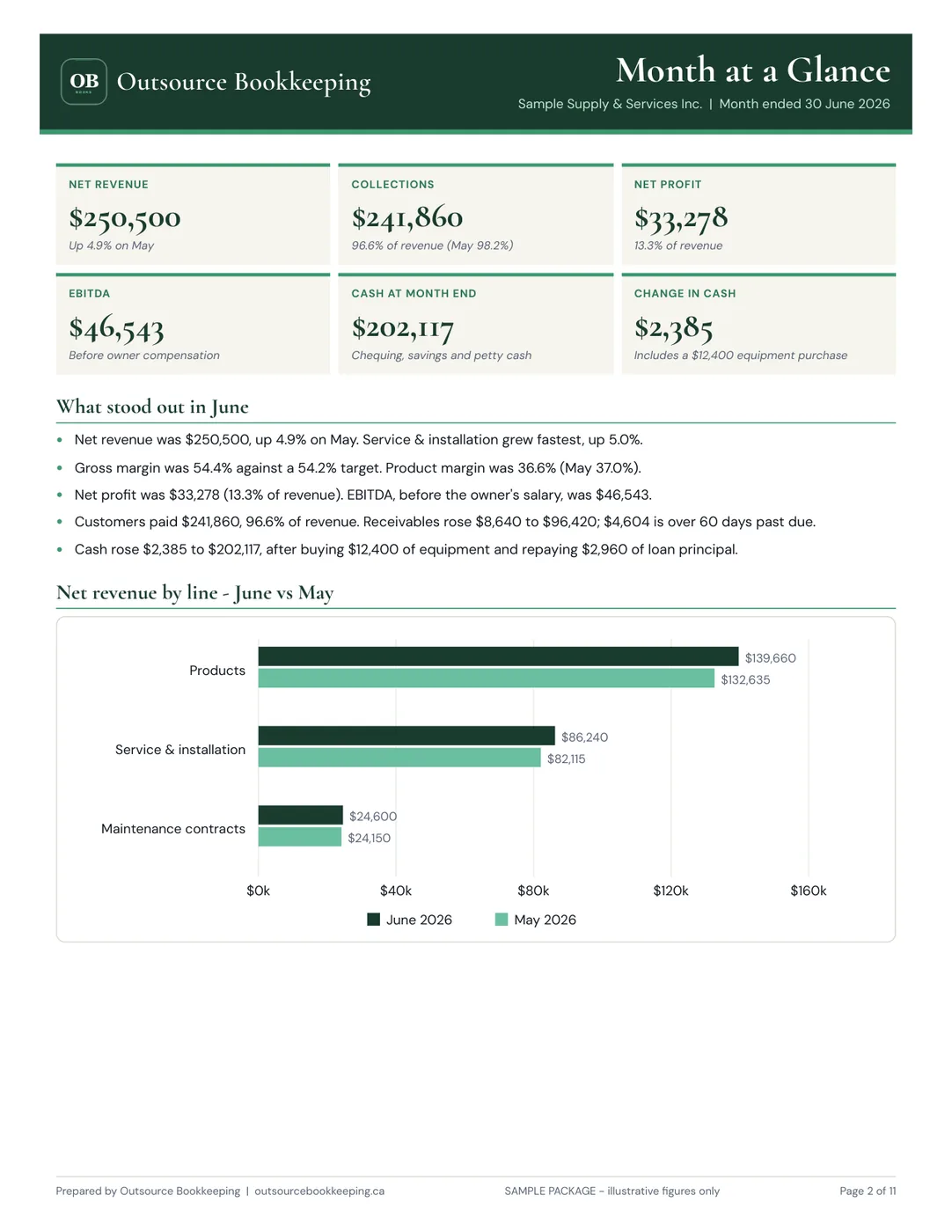
Need professional bookkeeping?
Outsource Bookkeeping delivers CRA-ready financial reports by the 10th of every month — flat rate, no surprises. See our pricing →
