
Should I do my own bookkeeping? Most owners ask us that after a Sunday evening spent staring at four months of unreconciled bank transactions, and they expect a bookkeeping firm to say no. We don't always say no. Some businesses should do their own books. Others are spending far more on DIY than a monthly fee would cost them — they never see the invoice, because there isn't one.
We'd sort it out with you across the desk in four passes: where DIY holds up, what it costs you, the five failures we find in nearly every cleanup file, and the point where handing it off pays for itself.
When doing your own bookkeeping actually works
There's a real profile where DIY is the right answer, and it's more common than bookkeepers like to admit.
You're a sole proprietor or a one-shareholder corporation. Fewer than about 40 transactions a month. One business chequing account, one business credit card, and no personal spending running through either. No employees, no subcontractors you have to issue slips for. And either you're under the $30,000 HST registration threshold, or you're registered but your sales are plain — no exempt supplies, no zero-rated exports, no US platform income.
If that's you, buy a QuickBooks Online or Wave subscription, connect the bank feed, categorize weekly, and reconcile monthly against the statement. Two hours a month, give or take. Paying someone $400 a month to do two hours of simple work is a bad trade, and we'd tell you so. Our step-by-step guide to small business bookkeeping covers the setup.
One condition, and it's the one that breaks: you have to do it. Every month. Bookkeeping you do in April for last year isn't DIY bookkeeping. It's a cleanup job you're performing on yourself, under deadline, without the tools.
The real cost of doing your own bookkeeping
Owners price DIY at zero because no invoice arrives. That's the whole mistake.
Track the hours for one month — chasing receipts, categorizing, reconciling, hunting the one transaction that won't tie, second-guessing whether the hardware store charge was supplies or equipment. For a business with any complexity, six to ten hours a month is normal. They're rarely the calm scheduled hours you planned. They're Sunday night, after the kids are down.
Now put a number on the hour. Use your marginal rate, not your average one. If you bill $120 and you'd fill the hour, eight hours of bookkeeping costs you $960 in forgone revenue. If you're not billable, ask what eight hours of quoting and selling is worth. Either way it isn't zero, and it isn't close.
Then there's the cost that shows up late: your accountant's year-end bill. A file with unreconciled accounts and a swollen "Uncategorized Expense" line takes hours to clean before anyone can prepare a T2 or a T2125, and that cleanup is billed at accountant rates, not bookkeeper rates. We regularly see year-end fees run $800 to $2,000 higher on DIY files for exactly this reason. Set that against a year of monthly bookkeeping and the saving gets thin.
The five things that go wrong in DIY books
These aren't intelligence failures. They're the parts of bookkeeping that look finished when they aren't — which is precisely why they survive until year-end.
HST filed off the bank balance. The expensive one. An owner eyeballs deposits, estimates the HST portion, and remits. Input tax credits get missed entirely, the filed figure never matches the books, and the CRA's record and yours drift apart quietly. If you're registered, the return should come off reconciled sales, not a bank app. Our HST/GST filing guide sets out what the return actually needs.
Accounts that were never truly reconciled. Bank feeds create a convincing illusion. Transactions flow in, get categorized, and the P&L fills up — but until the closing balance matches the statement, you don't know what's missing or doubled. Duplicates from a re-linked feed are one of the most common things we find.
Personal spending inside the business. One card used for both. The gas fill on the way to the cottage. Individually trivial, collectively a mess — and in a corporation it becomes a shareholder loan balance nobody tracked, which your accountant has to unwind at year-end.
No receipt trail. The CRA expects you to keep supporting records for six years, and a bank line is not a receipt. "MERCHANT 4471" tells an auditor nothing about business purpose. Capture as you go — Dext, Hubdoc, even a dedicated email folder — because reconstructing eighteen months of receipts after the fact is close to impossible.
The catch-all account. "Ask My Accountant" starts as a parking spot for one confusing transaction and ends the year holding $40,000 of unclassified activity that someone has to sort line by line.
None of these announce themselves. The books look fine on screen in July. They fall over in February, which is exactly why owners are so often blindsided. The warning signs are worth knowing early.
Should I do my own bookkeeping? Four questions that settle it
Answer these honestly. They decide it faster than any cost calculator.
1. Is the file current today?
Not "will be current." If your last completed reconciliation is more than 60 days old, DIY has already stopped working — you're just not far enough behind to feel it. Every backlog we clean started as one skipped month.
2. Can you state your HST position from the books?
If you're registered, you should be able to say what you collected and what you're claiming in input tax credits for the current period without guessing. If that number lives in your head or in your bank balance, the filing is a coin flip.
3. What did last year-end actually cost?
Pull the invoice. If your accountant billed materially more than the quote, or there were "adjustments" and "bookkeeping cleanup" lines on it, you already paid for a bookkeeper — at accountant rates, after the fact, with none of the monthly benefit.
4. What else would those hours buy?
Eight hours a month is roughly 100 hours a year. If a hundred hours pointed at sales or hiring would move your revenue by more than $400 a month, you have your answer.
DIY vs. hiring a bookkeeper, by business profile
| Business profile | DIY workable | Where it usually breaks |
|---|---|---|
| Sole prop, under 40 transactions a month, not HST registered | Yes | Falling behind, then a year-end scramble |
| HST-registered consultant, 40 to 100 transactions a month | Borderline | HST filed off the bank balance, missed ITCs |
| Any business with employees or subcontractors | No | Source deductions, slips, contractor misclassification |
| Two entities, inventory, or foreign currency | No | Intercompany entries, cost of goods, FX gains |
| Over roughly $1M in revenue | No | Stale numbers driving real decisions |
Borderline is the honest verdict for a lot of Canadian consultants and small trades. It means DIY can work, but only with a genuine monthly habit and someone reviewing the file before it reaches year-end.
The crossover point where hiring pays for itself
Flat-rate monthly bookkeeping for a typical Canadian small business runs $350 to $600. Our plans start at $500 on the pricing page, and going rates across the market sit in a similar band.
Set that against eight hours of your time, plus $800 to $2,000 of avoidable year-end cleanup, plus the input tax credits a guessed HST return leaves on the table. For most businesses past the simple sole-prop stage, the monthly fee is the cheaper line — often by a wide margin, and that's before counting the errors you never made. If you're close to the line, the timing question is worth its own read.
The crossover is a complexity number more than a revenue number. The month you add an employee, a second entity, inventory, or an HST filing obligation, DIY stops being a sensible use of an owner's evening.
The middle path most owners miss
Plenty of owners split the work. They keep the daily capture — snapping receipts, coding transactions in QuickBooks as they land — and hand off the parts that need judgment: reconciliations, HST returns, adjusting entries, and the monthly close. Some firms price that below a full-service plan, since the coding is already done.
The honest catch is that it only works if you hold up your end. When the coding stops during a busy month, the reviewer inherits a backlog, and the arrangement quietly turns into a cleanup engagement at a higher price. If you already know you won't keep the habit, buy the full scope and stop negotiating with yourself about it.
If you're already behind
Don't try to DIY your way out of a long backlog. Fourteen months of unreconciled transactions is a different job from monthly bookkeeping — statements pulled, feeds re-linked, duplicates hunted, prior HST filings checked against what the books actually say, usually in a specific order. Owners who attempt it over a weekend generally produce a second mess on top of the first.
Get the backlog closed properly, then decide DIY or not from a clean starting point. That's what catch-up bookkeeping is for, and what the process involves is worth reading before you start.
Where to start
Do the count before anything else. Three months of statements, transaction lines per month, the hours you actually spent last month, and last year's accounting invoice. Those four numbers answer the question better than any article can.
If they point toward handing it off, get a quote with your real volume in hand and compare it against what DIY is costing you — hours, year-end fees, and all. If they point toward keeping it, keep it, and put a recurring block on the last Friday of every month so it stays that way.
Frequently Asked Questions
See the work before you buy it
This is what lands in your inbox by the 10th.
A 11-page management package and the matching Excel workbook — your P&L against industry targets, EBITDA with owner-pay scenarios, and a cash flow written in sentences. Read the real thing, page by page.
See the full package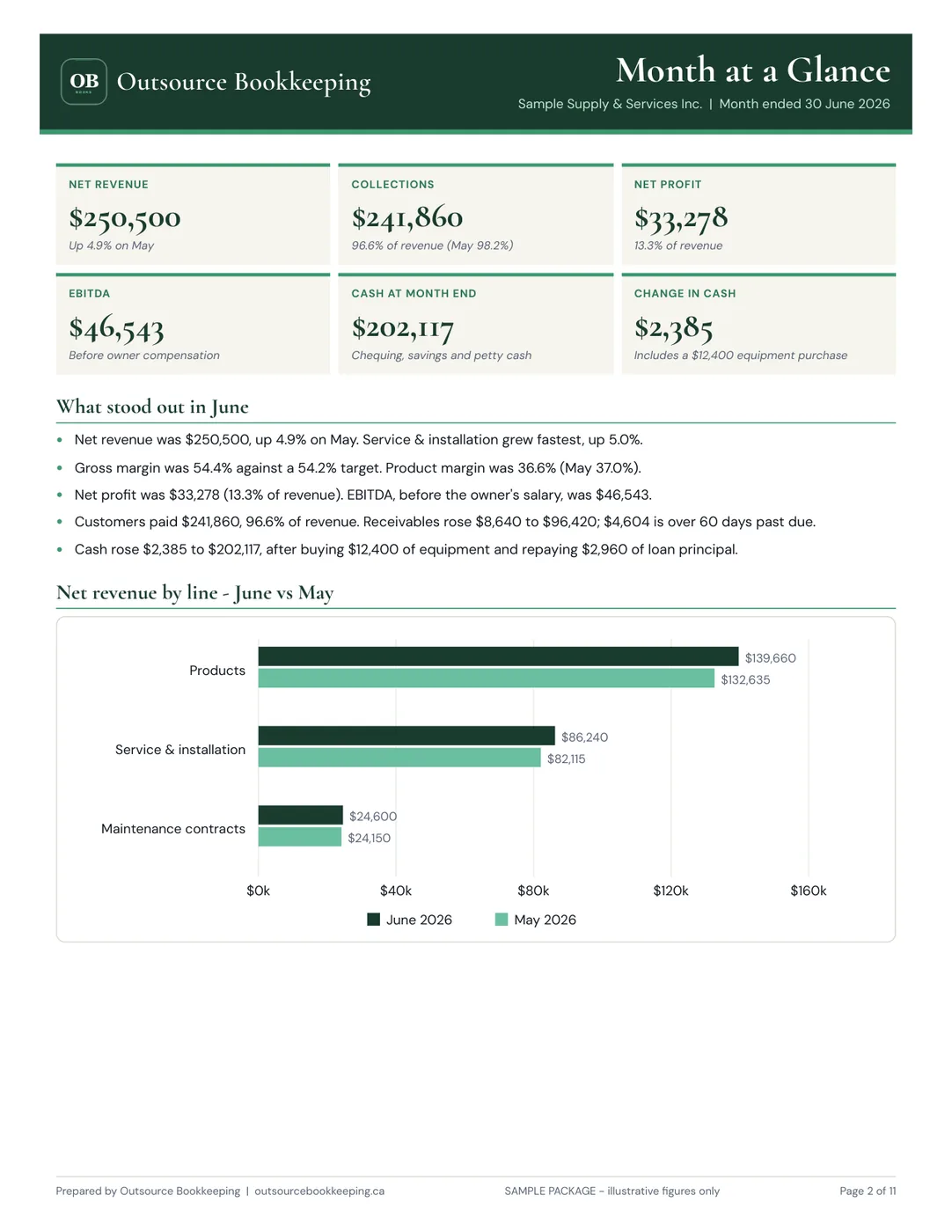
Need professional bookkeeping?
Outsource Bookkeeping delivers CRA-ready financial reports by the 10th of every month — flat rate, no surprises. See our pricing →
