
Most people hire a bookkeeper off a price and a friendly phone call. Then they spend the next year wondering why the numbers land three weeks late.
The questions to ask a bookkeeper before hiring aren't complicated, but they do have to be specific. Vague questions get vague answers, and "yes, we're very thorough" tells you nothing at all. Below are 14 questions worth asking, grouped by what each one actually reveals — with the answer worth hearing, and the answer that should end the conversation.
What to have ready before the call
Five minutes of prep makes every quote you get comparable:
- ●Your last filed return — a T2 if you're incorporated, a T2125 if you're a sole proprietor.
- ●How many bank accounts, credit cards, and loans the business runs through.
- ●Whether you're registered for HST/GST, and how often you file.
- ●A rough monthly transaction count. Pull three months of statements and count the lines.
- ●How far behind you are, honestly. Six months of untouched books is a different job than a clean handoff, and pretending otherwise just produces a quote that gets revised later.
Without those numbers, anyone quoting you a price is guessing. If a bookkeeper gives you a firm monthly fee before asking for any of it, that's your first data point.
Questions to ask a bookkeeper about experience
1. Who actually does my books, and what are they qualified in?
You want a named person, plus the name of whoever reviews their work. In Canada anyone can use the title "bookkeeper" — there's no licensing body standing behind it — so look for CPB Canada certification, a Chartered Professional Accountant designation, or supervision by one. The warning sign is a firm that will only say "our team handles that." Teams don't reconcile accounts. People do.
2. How many clients do you have that look like me?
Size and industry both matter. A bookkeeper who runs 40 e-commerce files knows what Shopify payouts look like when they hit the bank net of fees. One who's never seen it will book the deposit as revenue and understate your sales all year. "We work with everyone" isn't a credential.
3. Have you handled a CRA review or an audit request?
Ask what happened and what they had to produce. A good answer is procedural and slightly boring — they pulled the general ledger, matched the sampled transactions to source documents, sent it in. Someone who's never fielded a CRA request isn't disqualified, but you should know that going in. Our guide to CRA bookkeeping requirements covers what they'd need to produce.
4. What do you not do?
Every bookkeeper has a line where their work stops and an accountant's begins. You want them to name it clearly — most stop before corporate tax returns and tax planning. If the answer is "we handle everything," they either don't understand the boundary or they're overselling. The split is worth understanding before you hire either one; we break it down in bookkeeper vs. accountant.
Questions to ask about software and access
5. What software do you work in, and whose name is the subscription in?
QuickBooks Online and Xero are the two defaults in Canada, and both are fine. What matters more is the subscription. It should be in your business's name, billed to you, with the bookkeeper added as a user. When it's in their name, your accounting file is their asset. That's a bad position to be in the day you want to leave.
6. How do receipts get to you?
Look for a receipt capture tool — Dext and Hubdoc are the common ones — plus live bank feeds. The answer you don't want is an email address you forward things to, or worse, a folder you drop scans into once a quarter. Receipt handling is where most bookkeeping relationships quietly fall apart.
7. If I leave, what do I get and how quickly?
Ask it plainly, before you sign. The right answer is that you keep the file, admin access transfers within a few business days, and nobody charges you for it. Hedging here predicts everything else. Your ledger and its history belong to your business, full stop.
Questions to ask about process and deadlines
8. What date do my books close each month?
You want a committed calendar date — "financials in your inbox by the 15th" — not a feeling. This single question separates firms with an actual close process from firms that work whenever the inbox gets loud. Ask what happens when they miss it, too.
9. Which accounts get reconciled every month?
Every bank account, every credit card, every loan, and the HST control account. All of them, monthly. Plenty of bookkeeping arrangements reconcile the main chequing account and call it done, which is how a business gets to year-end with a credit card that hasn't been touched since March and an accountant billing $200 an hour to sort it out. A proper monthly close covers all of it.
10. Who files my HST/GST, and who's on the hook if it's late?
Filing and remitting can sit with either side, and both arrangements work — what causes damage is each party assuming the other owns it. Get it in writing. Late HST filing carries penalties plus interest, and the CRA doesn't care that there was confusion about scope.
11. Am I behind, and what does fixing that cost?
If you're months behind, that's a separate job with a separate price, and it should be quoted separately. A bookkeeper who folds twelve months of cleanup into a flat monthly fee without scoping it will either cut corners or come back for more money. Ask for the catch-up work to be priced on its own — we explain how that scoping normally works in our catch-up bookkeeping guide.
Questions to ask about communication
12. Who do I contact, and when will they reply?
A named person and a stated response window — one to two business days is normal. A shared inbox with nobody's name on it means your question competes with everyone else's. Also ask who covers that person in August and over the December holidays, because those are exactly the weeks a payroll remittance or an HST deadline gets missed.
13. What do you do when you can't categorize something?
The answer you want involves a running list. Good bookkeepers park what they can't identify in an uncategorized holding account and send you one consolidated question list each month. The answers you don't want are at either extreme: guessing, or emailing you about every $12 charge. Both are failures of process.
Pricing questions to ask before hiring a bookkeeper
14. Is this flat-rate or hourly, and what changes it?
Flat monthly pricing is easier to budget and removes the awkwardness of being billed to ask a question. But flat only works if both sides know what it's based on — usually transaction volume and the number of accounts being reconciled. Ask what specifically pushes you into the next tier, so a busy season doesn't produce an invoice you didn't expect. Hourly isn't automatically worse, but hourly with no estimate and no cap is. For market context, see our breakdown of bookkeeping rates in Canada, and our own flat-rate plans start at $500/month on the pricing page.
Then ask the question people skip: what isn't included? Year-end corporate tax filing, personal returns, payroll processing, and catch-up work are all commonly excluded. There's nothing wrong with that — it's only a problem when you find out in February.
Warning signs at a glance
| Area | Answer you want | Warning sign |
|---|---|---|
| Who does the work | A named bookkeeper, plus a named reviewer | "Our team handles it" |
| Software | QuickBooks Online or Xero, subscription in your name | A portal you can't export from |
| Monthly close | A committed date every month | "As soon as we get to it" |
| Reconciliations | Every bank, card, loan and HST account | Chequing account only |
| Leaving | Full file and admin access within days | Delays, or a fee for your own data |
| Pricing | Flat fee with the tier triggers spelled out | Hourly, no estimate, no cap |
That table is the compressed version. The full set of red flags when hiring a bookkeeper works through nine of them in detail, including what each one costs you once the file is already theirs.
Where to start
Pick three firms. Ask all 14 questions, in the same order, and write the answers down — patterns show up fast once they're side by side on paper. Then call two references each and ask about deadlines and mistakes rather than whether they're happy.
If you're still deciding whether you need this at all, when to hire a bookkeeper is the better starting point, and how to choose a bookkeeping service covers the selection criteria behind these questions. When you're ready to compare us against whoever else you're talking to, get a quote — the answers to all 14 are ones we're happy to give on a 15-minute call.
Frequently Asked Questions
See the work before you buy it
This is what lands in your inbox by the 10th.
A 11-page management package and the matching Excel workbook — your P&L against industry targets, EBITDA with owner-pay scenarios, and a cash flow written in sentences. Read the real thing, page by page.
See the full package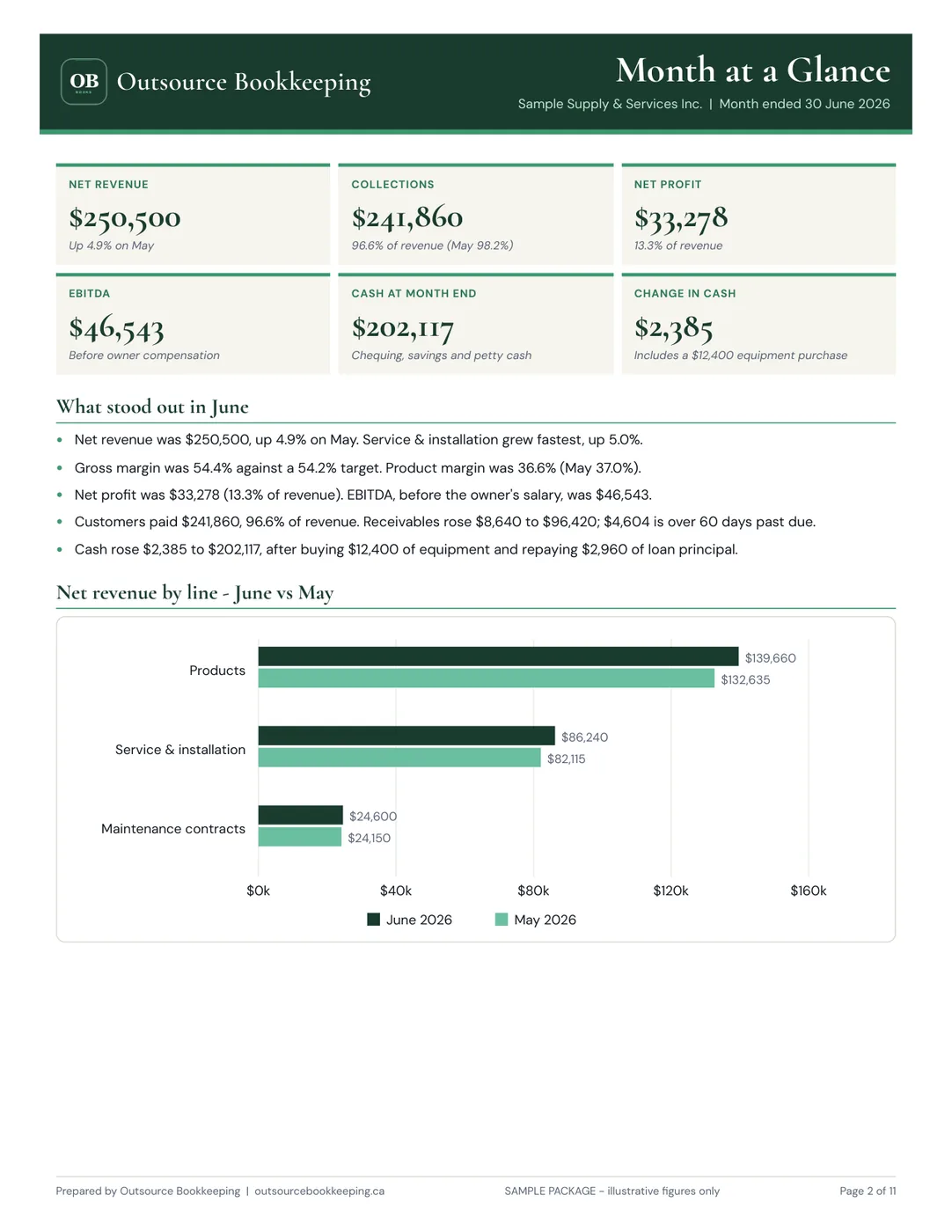
Need professional bookkeeping?
Outsource Bookkeeping delivers CRA-ready financial reports by the 10th of every month — flat rate, no surprises. See our pricing →
