
What Are the CRA Bookkeeping Requirements?
The Canada Revenue Agency requires every Canadian business to maintain adequate books and records that:
1. Support all amounts reported on your T1 or T2 tax return 2. Are kept in English or French 3. Are maintained at your place of business, your accountant's office, or another approved location 4. Are available to CRA on request (for audit or review purposes)
"Adequate" means your records must allow CRA to verify your income, deductions, and credits. If a CRA auditor asks you to support a deduction, you need documentation.
---
How Long Must You Keep Business Records in Canada?
The standard CRA record retention period is 6 years from the end of the tax year the records relate to.
| Tax Year End | Records Must Be Kept Until |
|---|---|
| December 31, 2024 | December 31, 2030 |
| December 31, 2023 | December 31, 2029 |
| March 31, 2025 | March 31, 2031 |
Important exceptions: - If you filed your return late, the 6-year clock starts from the date you filed, not the year-end - If you have an open objection or appeal with CRA, keep records until it is resolved plus 2 years - Corporation minute books and share registers must be kept for 2 years after the corporation is dissolved - Capital property records (buildings, major equipment) should be kept for 6 years after you sell the property — so potentially much longer than 6 years
---
What Records Must Canadian Businesses Keep?
Income Records - All sales invoices issued to customers - Cash register tapes / POS records - Bank deposit slips - E-transfer and payment processor records (Stripe, Square, PayPal) - Contracts with clients
Expense Records - All purchase invoices and receipts - Supplier contracts - Credit card statements (with supporting receipts) - Bank statements
Payroll Records - T4 slips and T4 Summary filed with CRA - Pay stubs for each employee - Records of Employment (ROEs) issued - Payroll remittance confirmations (PD7A) - Vacation pay records
Sales Tax Records - HST/GST returns filed with CRA (all periods) - HST/GST working papers showing calculation - PST returns (BC, Saskatchewan, Manitoba) - QST returns (Quebec) - Input Tax Credit supporting receipts
Vehicle Records (if claiming vehicle expenses) - Vehicle mileage log — date, destination, business purpose, kilometres - Fuel receipts - Repair and maintenance receipts - Insurance records
Home Office Records (if claiming home office) - Home size calculation (business-use percentage) - Mortgage interest or rent records - Utility bills - Property tax records
Capital Asset Records - Purchase invoices for any asset over $500 (computers, vehicles, equipment) - Records of improvements to assets - Disposal records when assets are sold
Corporate Records (Corporations Only) - Articles of incorporation - Shareholder meeting minutes - Directors' meeting minutes - Share register - Shareholder loan account records
---
Digital Records vs. Paper Records
CRA accepts digital records — you do not need to keep paper copies if you have reliable digital versions.
Acceptable digital formats: - Scanned PDF copies of invoices and receipts - Exports from accounting software (QuickBooks Online, Xero, Wave) - Digital bank statements - Email invoices
Requirements for digital records: - Must be readable and printable on request - Must be organized (not just a folder of unorganized files) - Must be backed up — CRA will not accept "my computer crashed" as an explanation for missing records
Best practice: Use QuickBooks Online or Xero to store transaction records digitally. Attach scanned receipts to transactions in the software. Your records become organized, searchable, and CRA-ready automatically.
---
What Happens If You Don't Keep Records?
If CRA audits your business and you cannot produce supporting records:
1. Deductions are disallowed — CRA removes the expense from your return, increasing taxable income 2. Reassessment — CRA issues a Notice of Reassessment with additional tax owing plus interest (currently ~6–8% per year) 3. Gross negligence penalties — if the understatement is significant and CRA determines you were negligent, a penalty of up to 50% of the understated tax can be assessed 4. Criminal penalties — in fraud cases, criminal charges are possible
Even without penalties, losing receipts for $20,000 in expenses could cost $2,440–$5,300 in extra corporate tax (depending on your province and rate).
If your records are already incomplete or months behind, don't wait for a CRA letter to force the issue — a one-time catch-up bookkeeping project rebuilds and reconciles the missing months from your bank and credit card statements, so your books can support every deduction you've claimed.
---
CRA Bookkeeping Requirements by Business Type
| Business Type | Key Records | T-Return Filed |
|---|---|---|
| Sole proprietor | All income/expense records, HST | T1 with T2125 |
| Corporation | All above + minute books, share register | T2 |
| Partnership | Partner capital accounts, profit-sharing agreements | T5013 (if required) |
| Self-employed / freelancer | Client invoices, expense receipts, HST | T1 with T2125 |
---
How a Professional Bookkeeper Helps with CRA Compliance
A professional bookkeeper ensures your records are CRA-ready all year long:
- ●Every transaction is recorded and categorized with source documentation
- ●Bank reconciliations create a complete audit trail
- ●HST returns are filed on time with supporting working papers
- ●Year-end package provides your accountant with everything needed for T2 filing
- ●If CRA ever requests records, they are organized and retrievable
At flat rate from $500/month, Outsource Bookkeeping maintains CRA-compliant books for Canadian businesses in all provinces.
Book a free consultation → | See our services →
Related: HST/GST Filing Guide for Canadian Businesses → Related: Year-End Bookkeeping Checklist for Canadian Small Businesses →
Frequently Asked Questions
See the work before you buy it
This is what lands in your inbox by the 10th.
A 11-page management package and the matching Excel workbook — your P&L against industry targets, EBITDA with owner-pay scenarios, and a cash flow written in sentences. Read the real thing, page by page.
See the full package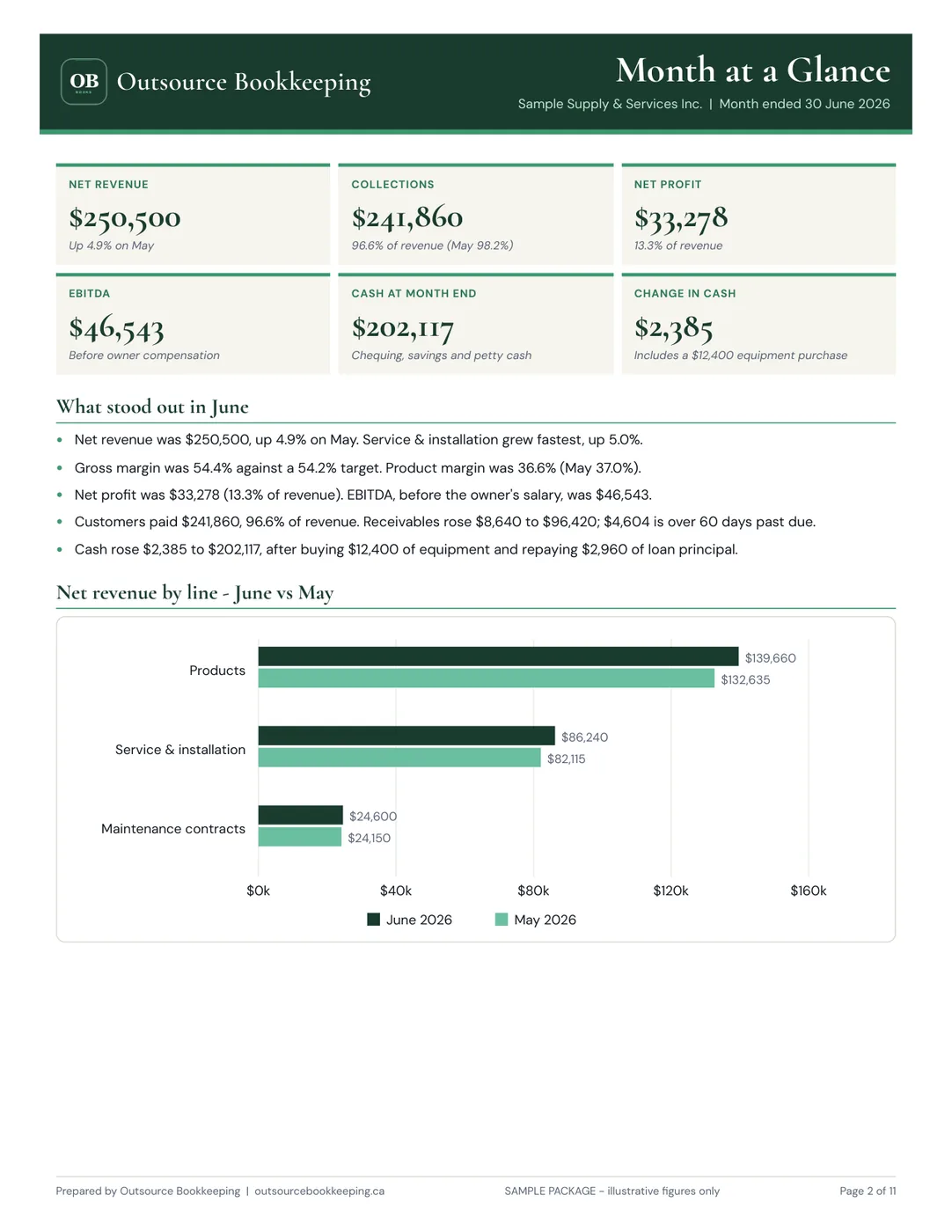
Need professional bookkeeping?
Outsource Bookkeeping delivers CRA-ready financial reports by the 10th of every month — flat rate, no surprises. See our pricing →
