
Do You Need to Register for HST in Canada?
If your Canadian small business generates revenue, you'll eventually need to register for HST (or GST, depending on your province) with the CRA. Understanding when registration is mandatory — and what happens after — is one of the most important early steps for any business owner.
The $30,000 Threshold: When Registration Is Mandatory
CRA requires HST/GST registration once your total taxable revenues exceed $30,000 in either: - A single calendar quarter (3-month period), OR - Four consecutive calendar quarters (rolling 12 months)
This threshold applies to your worldwide taxable revenue across all business activities. Once crossed, you have 29 days to register.
Example: If you're a consultant who earned $8,000 in Q1, $10,000 in Q2, and $13,000 in Q3 — your cumulative revenue crossed $30,000 in Q3. You must register within 29 days of that crossing.
What counts toward the $30,000 threshold? - All taxable and zero-rated supplies you make - Revenue from associated businesses (if you control them)
What does NOT count? - HST-exempt supplies (medical services, most financial services, residential rents) - Sales of capital assets (e.g., selling a vehicle used in your business) - Certain government grants
How to Register for HST with CRA — Step by Step
Step 1: Get a Business Number (BN) If you don't already have a CRA Business Number, you'll get one when you register for HST. Your BN is a 9-digit number that identifies your business with CRA. If you already have a BN (for payroll or corporate tax), you'll add an HST/GST program account to it.
Step 2: Register Online via CRA My Business Account
The fastest method: 1. Go to canada.ca/cra-business and log into My Business Account 2. If you don't have an account, register using your SIN and CRA login credentials 3. Select "Register for a business number and any CRA program accounts" 4. Choose "GST/HST" as the program account 5. Complete the registration form — business name, address, fiscal year-end, and estimated annual revenue 6. Submit — you'll receive your HST account number within 24–48 hours
Step 3: Determine Your Reporting Period
Your filing frequency depends on your annual revenue: - Annual filing — under $1,500,000 in annual taxable revenues (quarterly instalments may be required) - Quarterly filing — $1,500,000 to $6,000,000 in annual taxable revenues - Monthly filing — over $6,000,000 in annual taxable revenues
Most small businesses start with annual or quarterly filing. CRA assigns your frequency at registration — you can request a change if needed.
Step 4: Start Charging HST on Your Next Taxable Sale
From the date you're registered (or the date your effective date of registration), you must charge HST on all taxable supplies. Do not charge HST before your registration date — it is illegal to collect HST before you're registered.
Step 5: Claim Input Tax Credits (ITCs)
Once registered, you can claim ITCs for HST paid on business purchases. Keep all receipts and invoices. ITCs reduce your net HST payable — meaning you remit only the difference between HST collected and HST paid on business expenses.
HST Rates by Province (2026)
| Province | Tax | Rate |
|---|---|---|
| Ontario | HST | 13% |
| British Columbia | GST + PST | 5% + 7% = 12% |
| Alberta | GST only | 5% |
| Quebec | GST + QST | 5% + 9.975% |
| Nova Scotia | HST | 14% |
| New Brunswick | HST | 15% |
| Prince Edward Island | HST | 15% |
| Newfoundland & Labrador | HST | 15% |
| Manitoba | GST + RST | 5% + 7% = 12% |
| Saskatchewan | GST + PST | 5% + 6% = 11% |
Note: In provinces with HST (Ontario, Atlantic Canada), there is one combined registration with CRA. In provinces with separate GST and PST (BC, Manitoba, Saskatchewan), you register for GST with CRA AND separately with the provincial ministry for PST.
What Happens After You Register for HST?
1. Charge HST on taxable sales — add HST to your invoices at the applicable rate 2. File HST returns — quarterly or annually, depending on your revenue 3. Remit net HST — pay the difference between HST collected and ITCs claimed 4. Keep records — retain all sales invoices and purchase receipts for 6 years (CRA audit window)
Common HST Registration Mistakes to Avoid
1. Registering too late. Late registration means you may owe HST on sales made after crossing $30,000 even if you didn't collect it — you're still liable to remit it to CRA.
2. Not claiming ITCs. Many new registrants forget to claim ITCs on purchases made before registration (you can claim ITCs on inventory and capital property on hand at the time of registration).
3. Charging HST before your effective date. If you registered effective April 1, don't charge HST on March invoices — even if you're now registered.
4. Using the wrong rate. If your customers are in different provinces, you charge the HST rate based on the *place of supply* — generally where the customer is located, not where you are.
Should You Register Voluntarily Before $30,000?
Voluntary registration makes sense if: - You have significant HST-paid expenses (equipment, supplies, professional fees) and want to recover those ITCs - Your customers are businesses (not individuals) — they can claim your charged HST as their own ITC - You want to appear more established (registered businesses appear larger/more credible to B2B clients)
It does NOT make sense if: - Your customers are primarily individuals who can't claim ITCs — adding HST increases their cost by 13% - Your expenses are minimal and the ITC recovery wouldn't justify the filing burden
Getting Help with HST Registration and Filing
HST registration is straightforward — but ongoing HST filing is where most small businesses struggle. Correctly separating taxable vs. exempt revenues, maximizing ITCs, filing on time, and handling CRA correspondence requires attention every quarter.
We handle HST registration, ongoing quarterly filing, and CRA correspondence as part of our flat rate from $500/month bookkeeping service — so you never miss a deadline or leave money on the table.
Book a free consultation to get your HST setup right from day one.
Related: Bookkeeping for Small Business Canada → Related: How Much Does Bookkeeping Cost in Canada? →
Official Sources
All registration rules, thresholds, and deadlines in this guide are sourced directly from the Canada Revenue Agency:
Frequently Asked Questions
See the work before you buy it
This is what lands in your inbox by the 10th.
A 11-page management package and the matching Excel workbook — your P&L against industry targets, EBITDA with owner-pay scenarios, and a cash flow written in sentences. Read the real thing, page by page.
See the full package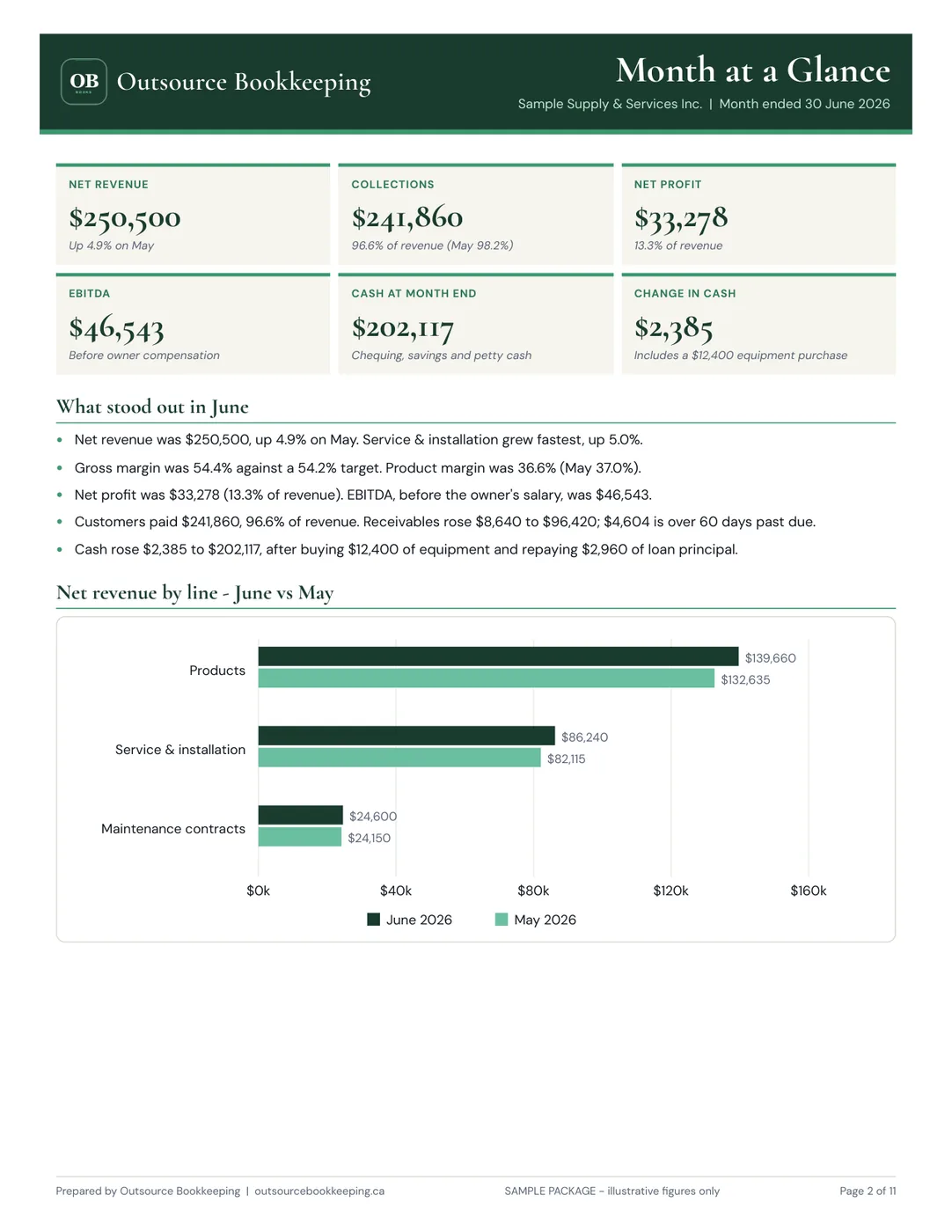
Need professional bookkeeping?
Outsource Bookkeeping delivers CRA-ready financial reports by the 10th of every month — flat rate, no surprises. See our pricing →
