
Why Year-End Bookkeeping Matters
Year-end bookkeeping is the process of closing out your financial records for the year and preparing them for tax filing. Done properly, it means:
- ●Faster tax filing — your accountant receives clean, organized records and spends less time (and charges less)
- ●Accurate tax return — every deduction is captured; nothing is missed or double-counted
- ●Lower accounting fees — accountants charge $150–$350/hour; messy books add 5–15 hours to their engagement
- ●CRA compliance — year-end reconciliations catch errors before CRA does
Whether you handle bookkeeping yourself or use a professional service, this checklist covers everything that must happen before your accountant files your return.
---
Year-End Bookkeeping Checklist for Canadian Small Businesses
Bank & Credit Card Reconciliation 1. **Reconcile all bank accounts** — every account must match the bank statement to the penny at year-end. Investigate and resolve any discrepancies. 2. **Reconcile all credit card accounts** — all credit card statements must match balances in your accounting software.
Accounts Receivable & Payable 3. **Review accounts receivable** — run an A/R aging report. Identify invoices more than 90 days overdue and determine if any should be written off as bad debts (bad debt write-offs are tax-deductible). 4. **Review accounts payable** — confirm all outstanding bills are entered. Any bills received before year-end should be recorded even if not yet paid.
Tax Accounts 5. **Reconcile HST/GST account** — compare the HST payable/receivable balance in your books against the total of all HST returns filed during the year. The two must match. Discrepancies indicate missing filings or recording errors. 6. **Verify payroll totals** — confirm total payroll expense, CPP, EI, and income tax withheld in your books matches your T4 Summary filed with CRA.
Fixed Assets 7. **Run fixed asset schedule** — list all capital assets (computers, vehicles, equipment), calculate Capital Cost Allowance (CCA) for the year, and record depreciation in your books. CCA is one of the most commonly missed deductions for Canadian small businesses.
Corporate Accounts (Corporations Only) 8. **Review shareholder loan account** — confirm the shareholder loan balance is correct. If you borrowed from the corporation or advanced money to it during the year, ensure all transactions are recorded. CRA scrutinizes shareholder loans — a debit balance (money owed to the corporation) must be repaid within one year of the corporation's year-end to avoid income inclusion.
Accruals & Adjustments 9. **Accrue outstanding expenses** — record any expenses incurred before year-end but not yet invoiced (e.g., legal fees, consulting, utilities). Accruals ensure the expense hits the correct tax year. 10. **Record prepaid expenses** — if you paid for expenses in advance (e.g., annual insurance premium, software subscriptions), record the prepaid portion as an asset rather than expensing it all in the current year. 11. **Count and record inventory** — if your business holds inventory, conduct a physical count at year-end and adjust your inventory balance in the books.
Final Steps 12. **Review petty cash** — reconcile petty cash fund and record any unrecorded expenses. 13. **Produce trial balance** — generate a trial balance (all account balances) and review for obvious errors before sending to your accountant. 14. **Organize source documents** — ensure all receipts, invoices, and supporting documents are filed and accessible by account and period. 15. **Back up all records** — ensure your accounting data is backed up (QuickBooks Online backs up automatically; local software requires manual backup).
---
Year-End Bookkeeping Deadlines in Canada
| Business Type | Books Should Be Ready | Tax Return Due | Tax Balance Due |
|---|---|---|---|
| Sole proprietor (Dec 31) | Early April | June 15 | April 30 |
| Corporation (Dec 31 year-end) | February/March | June 30 | March 31 (most CCPCs) |
| Corporation (other year-end) | 2 months after year-end | 6 months after year-end | 3 months (most CCPCs) / 2 months (other corps) |
| HST annual filer (Dec 31) | Same as above | March 31 | March 31 |
---
What Does a Bookkeeper Prepare for Your accountant?
When you use a professional bookkeeper, they deliver the following to your accountant at year-end:
- ●Trial balance — all account balances at year-end
- ●Bank reconciliation reports — for every bank and credit card account
- ●Fixed asset schedule — with CCA calculations for the year
- ●Payroll summary — reconciled to T4 Summary
- ●HST reconciliation — books vs. filed returns
- ●Shareholder loan statement (corporations)
- ●List of accruals and adjusting entries
- ●Organized receipts and source documents
Your accountant can file your T2 directly from this package — without spending hours cleaning up your books.
---
How Much Does Year-End Bookkeeping Cost in Canada?
| Scenario | Cost |
|---|---|
| Year-end included in monthly flat-rate service | Included — no extra charge |
| One-time catch-up + year-end package (1 year behind) | $500–$1,200 |
| One-time catch-up + year-end package (2+ years behind) | $1,200–$3,000+ |
| Accountant rework due to messy DIY books | $750–$3,500 (avoidable) |
With a monthly flat-rate bookkeeper, year-end is part of the service — no additional cost. The 15 steps above are completed as an extension of ongoing monthly work.
If the books weren't maintained during the year, get the backlog handled first: a one-time year-end catch-up bookkeeping project reconciles every month of the fiscal year and produces the accountant package in one pass — almost always cheaper than having your accountant do the cleanup at $150–$350/hour.
Outsource Bookkeeping: from $500/month flat — year-end package included, CRA-ready by January 31.
Book a free consultation → to get ahead of this year's year-end.
Related: CRA Bookkeeping Requirements for Canadian Businesses → Related: Bookkeeping vs. Accounting in Canada →
Frequently Asked Questions
See the work before you buy it
This is what lands in your inbox by the 10th.
A 11-page management package and the matching Excel workbook — your P&L against industry targets, EBITDA with owner-pay scenarios, and a cash flow written in sentences. Read the real thing, page by page.
See the full package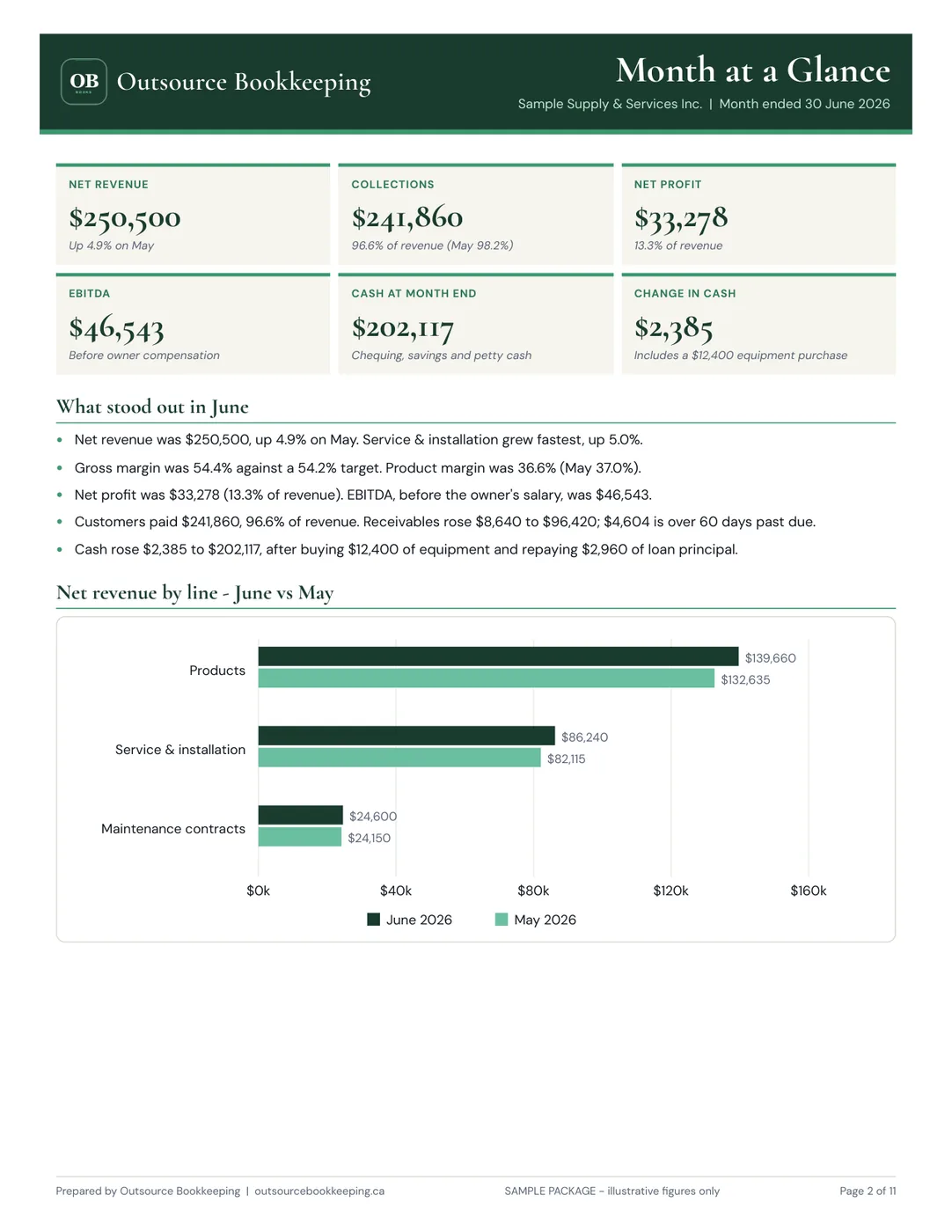
Need professional bookkeeping?
Outsource Bookkeeping delivers CRA-ready financial reports by the 10th of every month — flat rate, no surprises. See our pricing →
