
What Is a Bookkeeper?
A bookkeeper is responsible for recording, organizing, and maintaining your business's day-to-day financial transactions. This is the ongoing, operational financial work your business needs every single month:
- ●Recording all income and expenses in your accounting software (QuickBooks Online or Xero)
- ●Reconciling bank accounts and credit card statements
- ●Tracking accounts receivable (money owed to you) and accounts payable (bills you owe)
- ●Filing HST/GST returns with CRA each quarter
- ●Processing payroll and remitting payroll taxes
- ●Producing monthly financial reports (P&L, Balance Sheet, Cash Flow)
- ●Preparing a year-end package for your accountant
Bookkeeping happens throughout the year — month after month. It is the foundation that makes everything else in your finances possible.
In Canada, bookkeepers do not require an accountant designation. However, a qualified bookkeeper must have strong working knowledge of CRA rules, HST/GST by province, payroll remittances, and Canadian accounting standards.
---
What Is an Accountant?
A Chartered Professional Accountant is a licensed professional who analyzes financial data, provides strategic tax advice, and files corporate tax returns. Chartered Professional Accountants handle the higher-level, year-end work that requires professional licensing:
- ●Preparing and filing T2 corporate income tax returns
- ●T1 personal tax return preparation (individuals and self-employed)
- ●Tax planning — minimizing your tax liability within CRA rules
- ●Financial statement audits and reviews
- ●Shareholder remuneration strategies (salary vs. dividends)
- ●CRA audit representation
- ●Corporate restructuring and business valuations
Accountants engage with your business primarily at year-end and for special situations. They do not typically handle your month-to-month transaction recording — that's bookkeeping work.
---
Bookkeeper vs. Accountant: Key Differences
| Bookkeeper | Accountant | |
|---|---|---|
| What they do | Record and organize transactions | Analyze data and file taxes |
| When you need them | Monthly, year-round | Year-end / tax season |
| Typical cost (Canada) | $400–$700/month | $1,500–$5,000/year |
| Files HST/GST | Yes | Sometimes |
| Files T2 corporate tax | No | Yes |
| Chartered Professional Accountant designation required | No | Yes |
| Payroll processing | Yes | Sometimes |
| Financial strategy | Sometimes | Yes |
| Monthly reports | Yes | Rarely included |
---
Do I Need Both a Bookkeeper and an Accountant?
Yes — for most Canadian small businesses, the answer is both.
Here is how the division of work typically looks:
Your bookkeeper (year-round): - Handles bank reconciliation and transaction coding every month - Files your HST/GST returns quarterly - Manages payroll and T4 preparation - Delivers P&L, Balance Sheet, and Cash Flow reports by the 10th of every month - Prepares a clean, CRA-ready year-end package
Your accountant (once per year): - Receives your year-end package from the bookkeeper - Reviews the financials and asks follow-up questions - Prepares and files your T2 corporate return - Advises on tax planning opportunities for the next year
The bookkeeper's monthly work feeds directly into the accountant's year-end work. Clean, accurate books = faster tax filing + lower accounting fees.
---
Can a Bookkeeper File My Taxes in Canada?
This is one of the most common questions Canadian business owners ask — and the answer requires some nuance.
What a bookkeeper CAN file: - HST/GST returns with CRA (quarterly or annually) - Payroll remittances (CPP, EI, income tax) to CRA - T4 slips and T4 Summary - T4A slips for contractors
What a bookkeeper CANNOT file: - T2 corporate income tax return (requires an accountant) - T1 personal income tax return (requires a tax preparer or accountant) - Financial statement audits or reviews (requires an accountant)
Bookkeepers prepare your records so an accountant can file your taxes. The cleaner your books, the less time your accountant spends — and the lower your accountant bill.
---
How Much Does a Bookkeeper Cost in Canada in 2026?
| Option | Cost | What's Included |
|---|---|---|
| Flat-rate virtual bookkeeper | $400–$700/month | All transactions, HST, reports |
| Freelance bookkeeper (hourly) | $30–$60/hour | Varies by engagement |
| Part-time in-house bookkeeper | $2,500–$4,000/month | Employee, single hire |
| Full-time in-house bookkeeper | $55,000–$75,000/year | Full employee |
Outsource Bookkeeping: $800/month flat — unlimited transactions, all Canadian provinces, HST/GST filing included, CRA-ready reports by the 10th.
Book a free consultation → | See pricing →
Related: How Much Does Bookkeeping Cost in Canada? → Related: Virtual Accountant Canada →
Frequently Asked Questions
See the work before you buy it
This is what lands in your inbox by the 10th.
A 11-page management package and the matching Excel workbook — your P&L against industry targets, EBITDA with owner-pay scenarios, and a cash flow written in sentences. Read the real thing, page by page.
See the full package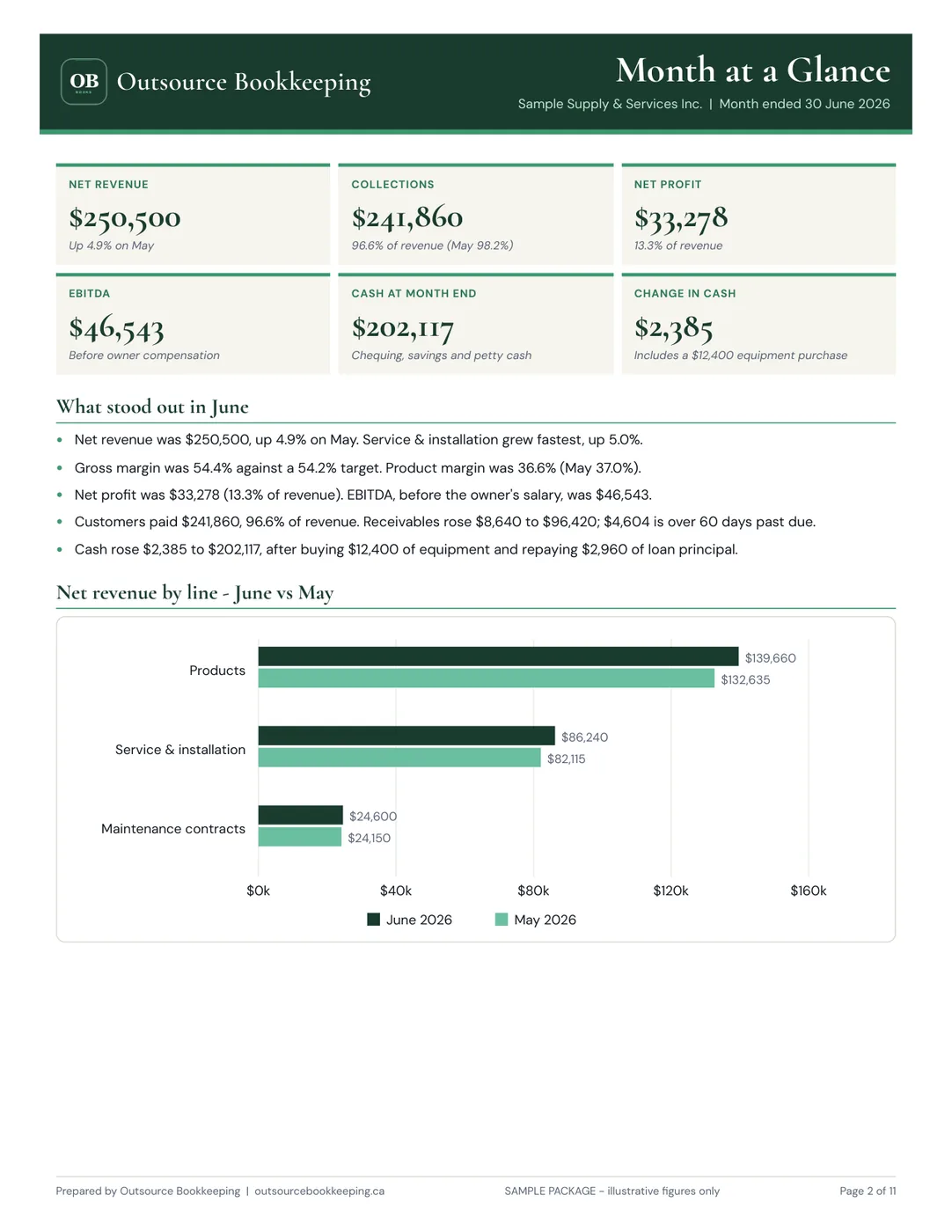
Need professional bookkeeping?
Outsource Bookkeeping delivers CRA-ready financial reports by the 10th of every month — flat rate, no surprises. See our pricing →
