
How to Choose a Bookkeeping Service in Canada
Choosing the wrong bookkeeper can cost you more than it saves — through missed deductions, late HST filings, and CRA penalties. Here are the seven criteria that matter most when choosing a Canadian bookkeeping service.
1. Canadian Tax Expertise
This is the most important criterion — and the most commonly overlooked. Canada's tax system varies significantly by province:
- ●Ontario, Atlantic provinces: HST (combined federal + provincial), single CRA filing
- ●Alberta: GST only (5%), no provincial tax
- ●BC: Separate GST (5%) to CRA + PST (7%) to BC Ministry of Finance
- ●Quebec: GST to CRA + QST (9.975%) to Revenu Québec
A bookkeeper without deep Canadian HST/GST knowledge will file incorrect returns, miss ITCs, and expose you to CRA reassessments. Ask specifically: "Which provinces have you filed sales tax for?" and "How do you handle Input Tax Credits?"
Red flag: A US-based bookkeeping service (Bench, Bookkeeper360) with no dedicated Canadian tax expertise.
2. Flat-Rate Pricing
Avoid hourly billing for ongoing monthly bookkeeping. Here's why:
- ●Your monthly cost becomes unpredictable — busy months (year-end, high sales volume) spike the bill
- ●Hourly bookkeepers have no financial incentive to work efficiently
- ●A typical small business with 100–200 monthly transactions costs $600–$2,000/month at hourly rates
What to look for: A single monthly flat rate that covers unlimited transactions, all provincial tax filings, and monthly reports — no line items, no overages.
3. A Fixed Monthly Delivery Date
This single criterion separates professional bookkeeping services from casual freelancers. Ask this question: "What date will I receive my monthly financial reports?"
- ●If the answer is "within a few weeks of month-end" — that's a red flag
- ●If the answer is a specific date (e.g., "the 10th of every month") — that's professional accountability
Without a fixed delivery date, your reports arrive whenever your bookkeeper gets around to them — making cash flow planning and accountant meetings nearly impossible to schedule.
4. QuickBooks Online or Xero — Not Proprietary Software
Your bookkeeping data should live in software you own and can access independently. Services that use proprietary platforms (like Bench's in-house software) create lock-in: if you switch providers, you lose easy access to your historical records.
QuickBooks Online and Xero are the two platforms that Canadian accountants and accountants work in natively. Your year-end package, tax return preparation, and banking integration all flow through these platforms seamlessly.
Ask: "Do you work in QuickBooks Online or Xero? Who owns the account?"
5. CRA-Ready Monthly Reports
Every month, you should receive three standard financial reports: 1. Profit & Loss Statement — revenue and expenses for the month and year-to-date 2. Balance Sheet — assets, liabilities, and equity at month-end 3. Cash Flow Statement — operating, investing, and financing cash movements
"CRA-ready" means your accountant can work directly from these reports for year-end tax filing — reducing their time, and your accounting bill.
Checklist: Ask to see a sample report package. If it's a one-page summary rather than GAAP-compliant financial statements, it won't meet your accountant's requirements.
6. All-Inclusive Scope
Hidden scope is how cheap-looking bookkeeping services become expensive. Before signing, confirm these are included in the flat rate:
- ●[ ] Bank and credit card reconciliation (all accounts)
- ●[ ] HST/GST/PST/QST filing with the relevant tax authority
- ●[ ] Monthly P&L, Balance Sheet, and Cash Flow reports
- ●[ ] Year-end package for your accountant
- ●[ ] Accounts payable and receivable tracking
- ●[ ] Chart of accounts setup and maintenance
If HST filing, year-end packages, or additional account reconciliations are billed separately — the true monthly cost is higher than advertised.
7. Dedicated Point of Contact
Your bookkeeper should know your business. When you have a question, you should be able to email or message a specific person — not submit a support ticket to a generic inbox.
Ask: "Will I have a dedicated bookkeeper? How do I reach them?"
Comparison: Local Bookkeeper vs. Online Bookkeeping Service
| Criterion | Local Bookkeeping Firm | Online Bookkeeping Service |
|---|---|---|
| Monthly cost | $75–$150/hr ($600–$2,000+) | $350–$600/month flat |
| Fixed delivery date | Rarely | Yes (professional services) |
| HST/GST included | Billed separately | Included at Outsource Bookkeeping |
| Software ownership | Varies | QuickBooks/Xero (you own it) |
| Year-end package | Extra charge | Included |
| Geographic limit | Local area only | All of Canada |
| Sick days / vacation gaps | Service disruptions | Team coverage |
The Bottom Line
The best bookkeeping service for your Canadian small business checks all seven boxes: Canadian tax expertise, flat-rate pricing, fixed delivery date, QuickBooks/Xero access, CRA-ready reporting, all-inclusive scope, and a dedicated contact.
Criteria are easier to check when you turn them into a script. Our list of questions to ask a bookkeeper before hiring covers these same seven areas phrased as questions, with the answer worth hearing and the one that should end the conversation.
Criteria also need candidates to apply them to. If you're still building a shortlist, where to find a bookkeeper in Canada compares the six channels that actually produce names — and which of them screen for competence before you ever make contact.
Criteria tell you what to look for; the inverse is just as useful. The red flags when hiring a bookkeeper covers the nine warning signs that should take a candidate off your shortlist, and what each one costs if you miss it.
Outsource Bookkeeping meets every criterion — from $500/month flat, all provinces, reports by the 10th, HST/GST included.
Book a free consultation → | See our pricing → | Compare with Bench →
Frequently Asked Questions
See the work before you buy it
This is what lands in your inbox by the 10th.
A 11-page management package and the matching Excel workbook — your P&L against industry targets, EBITDA with owner-pay scenarios, and a cash flow written in sentences. Read the real thing, page by page.
See the full package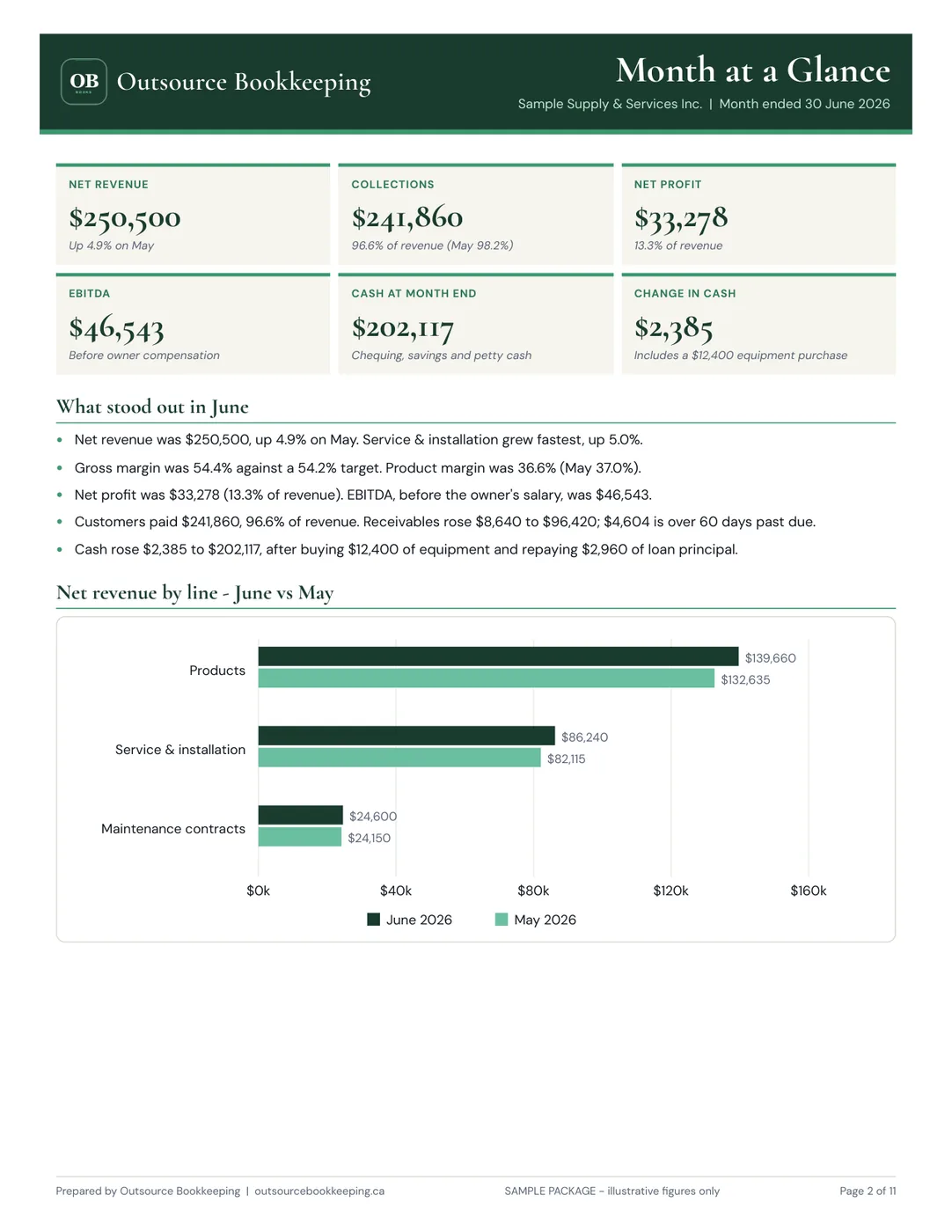
Need professional bookkeeping?
Outsource Bookkeeping delivers CRA-ready financial reports by the 10th of every month — flat rate, no surprises. See our pricing →
