
What is Bookkeeping?
Bookkeeping is the systematic process of recording, organizing, and maintaining all financial transactions of a business. Every time money moves — a customer pays an invoice, you pay a supplier, you run payroll, you buy equipment — that transaction is recorded in your books.
The word "bookkeeping" comes from the era of physical ledger books, but today it refers to the same process performed in accounting software like QuickBooks Online or Xero. The goal is the same: maintain a complete, accurate, and organized record of every financial event in your business.
Bookkeeping is not the same as accounting. Bookkeeping is the foundation. Accounting — done by a Chartered Professional Accountant — builds on that foundation to file taxes, develop strategy, and advise on financial decisions. Without good bookkeeping, accounting becomes slow, expensive, and unreliable.
Every Canadian business with revenue — sole proprietorships, partnerships, corporations, non-profits — is required by CRA to maintain accurate books. The question is not whether you need bookkeeping. It is whether yours is being done correctly.
What Does Bookkeeping Include?
Bookkeeping is broader than most business owners realize. A professional bookkeeper handles all of the following:
1. Transaction Recording and Categorization
Every financial transaction must be recorded in your accounting software and assigned to the correct account — office supplies vs. equipment, marketing vs. entertainment, HST-eligible vs. HST-exempt. Correct categorization is essential for accurate financial statements and CRA compliance. Misclassified transactions lead to wrong tax returns and potential audit triggers.
2. Bank and Credit Card Reconciliation
Every month, your bookkeeper reconciles your bank and credit card statements against your accounting records. This means confirming that every deposit and withdrawal in your bank account matches a transaction in your books. Reconciliation catches missing transactions, duplicate entries, bank errors, and fraud — and ensures your books match reality.
3. Accounts Receivable Management
Accounts receivable (AR) is the money your customers owe you. Your bookkeeper records every invoice you issue, tracks which ones have been paid, and flags outstanding receivables. Accurate AR ensures you know what cash is coming in and when — essential for cash flow management.
4. Accounts Payable Management
Accounts payable (AP) is the money you owe your suppliers and vendors. Your bookkeeper records bills received, tracks payment due dates, and ensures vendor payments are recorded correctly. Staying on top of AP prevents late payment penalties and keeps your balance sheet accurate.
5. HST/GST Preparation and Filing Support
If your business earns over $30,000 in annual revenue, you are required to register for HST/GST with CRA and file returns quarterly or annually. Your bookkeeper maintains a running HST/GST account, categorizes transactions as taxable, HST-exempt, or zero-rated, and prepares the data your accountant needs to file — or files directly if authorized. Errors in HST filings are one of the most common causes of CRA penalties for small businesses.
6. Payroll Recording
If you have employees or contractors, your bookkeeper records payroll runs, CPP contributions, EI premiums, and income tax withholdings. These amounts must be remitted to CRA on time — late payroll remittances carry significant penalties. Payroll recording also involves tracking vacation pay accruals, taxable benefits, and year-end T4 preparation.
7. Monthly Financial Report Preparation
At the end of each month, your bookkeeper produces three core financial reports: the Income Statement (Profit & Loss), the Balance Sheet, and the Cash Flow Statement. These reports give you a complete picture of your business's financial performance and position — revenue, expenses, net income, assets, liabilities, and cash on hand.
8. Year-End Package for Your accountant
At year-end, your bookkeeper prepares a complete, reconciled package of your financial records for your accountant to use in preparing your T2 corporate tax return (or T1 for sole proprietors). CRA-ready books dramatically reduce year-end accounting fees.
Bookkeeping vs. Accounting: The Key Difference
This distinction matters for both cost and compliance.
Bookkeeping is operational and ongoing: - Recording daily transactions - Reconciling bank accounts - Tracking AR and AP - Preparing monthly reports - Filing HST/GST
Accounting (done by an accountant) is strategic and periodic: - Preparing T1 or T2 tax returns - Tax planning and minimization strategies - Financial advice and projections - CRA audit representation - Compilation and review engagements
A common and expensive mistake: paying accountant rates ($150–$400/hour) for tasks that should be done by a bookkeeper ($25–$75/hour). When your accountant spends the first two hours of your year-end appointment cleaning up your books, that's $300–$800 in unnecessary cost. Clean bookkeeping delivered monthly eliminates this waste entirely.
Single-Entry vs. Double-Entry Bookkeeping
There are two methods of bookkeeping:
Single-entry bookkeeping — Records each transaction once, like a simple income/expense log or a personal bank register. It is simple but produces limited financial information and is not suitable for most businesses.
Double-entry bookkeeping — Records each transaction in two accounts: a debit and a credit. Every transaction has equal and opposite effects. When you collect $1,000 from a customer, you debit cash (asset increases) and credit accounts receivable (asset decreases). When you pay a $500 rent bill, you debit rent expense (expense increases) and credit cash (asset decreases).
Double-entry is the standard for all Canadian businesses using QuickBooks Online, Xero, or any professional accounting software. It is required to produce the three core financial statements and is the basis for GAAP-compliant reporting.
The Bookkeeping Cycle: How It Works Month-to-Month
Professional bookkeeping follows a consistent monthly cycle:
1. Collect source documents — Bank statements, credit card statements, invoices, receipts, payroll reports 2. Record and categorize transactions — Enter all transactions in QuickBooks Online or Xero with correct account codes 3. Reconcile bank and credit card accounts — Match every transaction to bank records; investigate and resolve discrepancies 4. Review AR and AP — Confirm outstanding invoices and bills are recorded; follow up on overdue items 5. Post payroll and remittances — Record payroll runs and CRA remittances (CPP, EI, income tax) 6. Prepare HST/GST data — Compile HST collected and paid for filing 7. Produce financial reports — Generate P&L, balance sheet, and cash flow statement 8. Deliver to client — Share reports with the business owner; flag unusual items or anomalies
At Outsource Bookkeeping, we complete this full cycle and deliver reports by the 10th of every month — so you always have current, accurate numbers before your business decisions need to be made.
What Software Do Canadian Bookkeepers Use?
The two dominant cloud accounting platforms in Canada are:
QuickBooks Online (QBO) — The most widely used small business accounting software in Canada. Integrates with CRA's My Business Account, major Canadian banks (for automatic transaction imports), and hundreds of third-party apps (payroll, invoicing, e-commerce). Available in Simple Start, Essentials, Plus, and Advanced tiers.
Xero — Popular alternative to QBO with a strong interface and robust bank feeds. Common in firms that work with multiple clients. Integrates well with Hubdoc for receipt management.
Both platforms support double-entry bookkeeping, HST/GST tracking, payroll, and financial reporting. The right choice depends on your business's size, industry, and integrations. A professional bookkeeper can set up and maintain either platform.
DIY Bookkeeping vs. Hiring a Bookkeeper
Many small business owners start by doing their own bookkeeping. This is understandable — software like QuickBooks makes it accessible. But as revenue grows, the cost of DIY bookkeeping compounds:
Time cost — Most business owners spend 5–15 hours per month on bookkeeping. At an opportunity cost of $100–$200/hour for the owner's time, that's $500–$3,000/month in lost productivity.
Error cost — Miscategorized transactions, missed HST filings, reconciliation errors, and inaccurate financial statements lead to CRA penalties and inflated accounting fees.
Decision cost — Business decisions made from inaccurate books — hiring decisions, pricing decisions, investment decisions — are more likely to be wrong.
Professional bookkeeping pays for itself. For most growing Canadian businesses, the break-even point on hiring a bookkeeper is well under $500/month in reclaimed time and reduced accounting fees.
How Much Does Bookkeeping Cost in Canada?
Bookkeeping pricing in Canada varies significantly by model:
Hourly freelance bookkeepers — $25–$75/hour. Variable costs; quality and availability varies.
Part-time in-house bookkeeper — $20–$35/hour plus employment costs (CPP, EI, vacation pay). Requires management and HR overhead.
Flat-rate managed bookkeeping services — $350–$750/month. Predictable costs, professional-grade service, no employment overhead.
Outsource Bookkeeping charges a flat $800/month for unlimited transactions, monthly HST/GST filing preparation, and CRA-ready P&L, balance sheet, and cash flow reports delivered by the 10th. No overages. No surprises.
What Happens Without Proper Bookkeeping
The consequences of neglected bookkeeping are serious:
CRA penalties — Late HST filings carry penalties of 1% of the amount owing plus 25% of that 1% for each full month late. Payroll remittance failures carry penalty rates of 3–10% depending on how late. These penalties compound.
CRA audit risk — CRA's audit selection algorithms flag inconsistent income reporting, unusually high expense ratios, and missing HST filings. Clean monthly books are your best audit defence.
Messy year-end — When an accountant must reconstruct 12 months of transactions from bank statements, receipts in a shoebox, and an unreconciled QBO file, expect fees of $2,000–$10,000+ for cleanup alone — on top of normal accounting fees.
Poor business decisions — Without accurate monthly financials, pricing, hiring, investment, and cash flow decisions are made on guesswork.
Financing difficulties — Banks and lenders require current financial statements. Businesses without clean monthly books often cannot access lines of credit or term loans when they need them most.
Investing from $500/month in professional bookkeeping eliminates all of these risks. It is one of the highest-ROI decisions a growing Canadian business can make.
Getting Your Books in Order
Whether your books are current or months behind, the right time to get professional bookkeeping in place is now. Clean books mean lower accounting fees, better business decisions, faster access to financing, and zero stress at tax time.
Explore our monthly bookkeeping service or compare options in our bookkeeper vs. accountant guide. See our transparent pricing — flat rate from $500/month, no contracts.
Book a free consultation and we'll assess your current books, identify what needs to be caught up, and get you on a clean monthly schedule within days.
Frequently Asked Questions
See the work before you buy it
This is what lands in your inbox by the 10th.
A 11-page management package and the matching Excel workbook — your P&L against industry targets, EBITDA with owner-pay scenarios, and a cash flow written in sentences. Read the real thing, page by page.
See the full package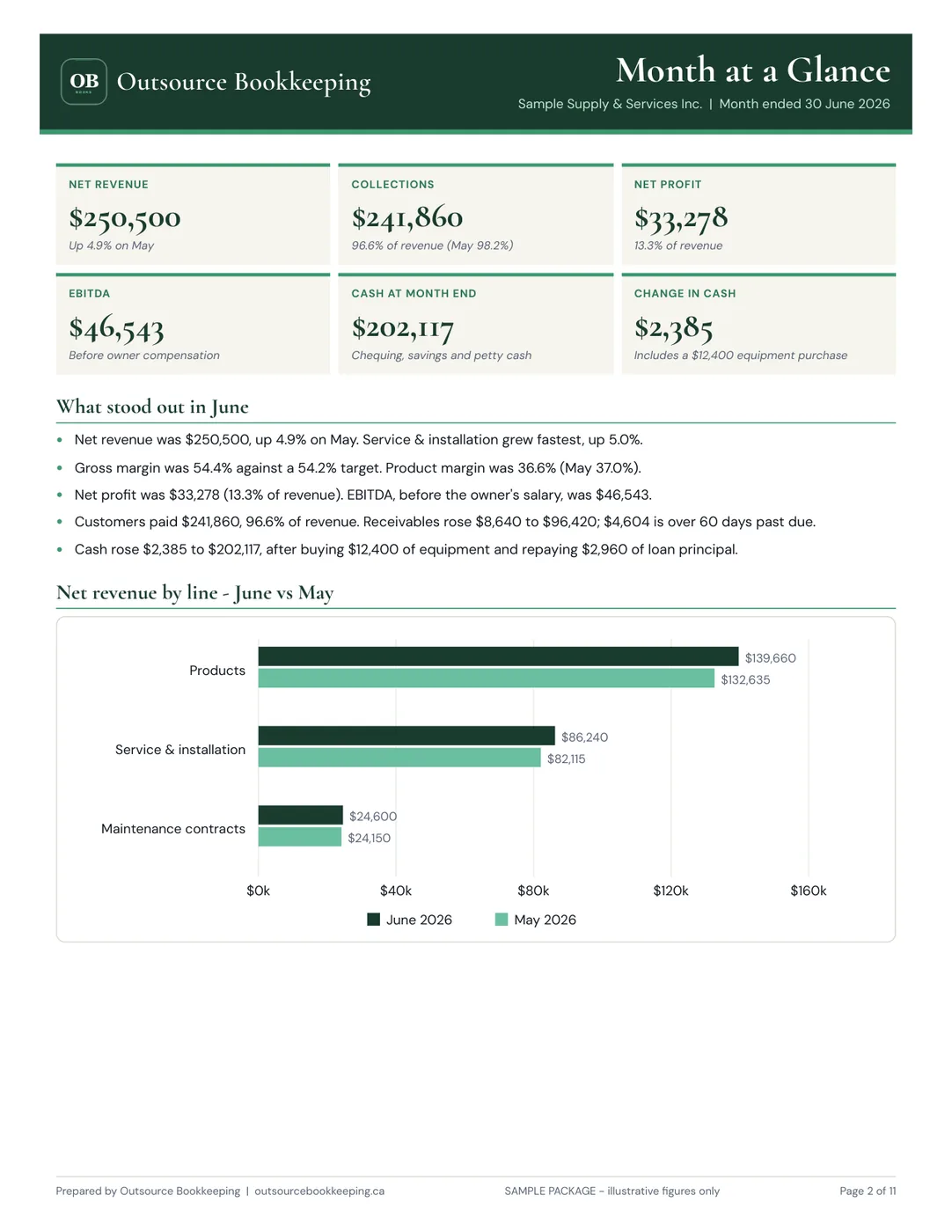
Need professional bookkeeping?
Outsource Bookkeeping delivers CRA-ready financial reports by the 10th of every month — flat rate, no surprises. See our pricing →
