
What Are Financial Statements?
Financial statements are formal reports that summarize the financial activity and position of a business over a specific period. They translate thousands of individual transactions — invoices issued, expenses paid, payroll runs, loan payments — into a clear, structured picture of how a business is performing financially.
For Canadian small businesses, financial statements serve several critical purposes:
- ●CRA compliance — Required for corporate T2 returns and CRA audit defence
- ●accountant year-end work — accountants build your tax return from your financial statements
- ●Bank financing — Lenders require financial statements to assess creditworthiness
- ●Business decisions — Understanding profitability, cash flow, and financial position guides strategic choices
- ●Investor and partner reporting — Stakeholders need formal financial reports
Financial statements are not the same as bookkeeping. Bookkeeping is the ongoing process of recording transactions. Financial statements are the reports produced from that data. No accurate bookkeeping means no reliable financial statements.
The Three Core Financial Statements
Every Canadian business needs three financial statements. Think of them as three lenses that each show a different dimension of your financial health.
1. Income Statement (Profit & Loss / P&L) — Shows what you earned and spent over a period, resulting in net profit or loss.
2. Balance Sheet — Shows what you own (assets), what you owe (liabilities), and the net difference (equity) at a specific point in time.
3. Cash Flow Statement — Shows where cash came from and where it went, broken into operations, investing, and financing activities.
Each statement tells a different story. A business can show a profit on the income statement but still run out of cash (common for businesses with slow-paying customers). Understanding all three together gives you the full picture.
The Income Statement (Profit & Loss)
The income statement — also called the P&L — covers a time period (a month, a quarter, a year) and answers the question: was the business profitable?
Key Components
Revenue (Sales) — All income earned from your primary business activities. This is recorded when earned, not necessarily when cash is received (accrual accounting).
Cost of Goods Sold (COGS) — The direct costs of producing what you sell. For a retailer, this is inventory cost. For a contractor, it's materials and direct labour. Not all businesses have COGS — service businesses often go straight to gross profit.
Gross Profit — Revenue minus COGS. This is what you earned before overhead expenses. *Gross Profit = Revenue − COGS*
Operating Expenses — The indirect costs of running the business: rent, utilities, salaries (non-production), marketing, professional fees, insurance, office supplies.
Operating Income (EBIT) — Gross profit minus operating expenses. Earnings Before Interest and Taxes.
Net Income — The bottom line after all expenses, including interest and income taxes. This is what flows into the equity section of your balance sheet.
A well-maintained income statement lets you spot margin problems, identify expense categories that are growing too fast, and compare performance month-over-month or year-over-year.
The Balance Sheet
The balance sheet is a snapshot — it shows your business's financial position at a single point in time (e.g., December 31, 2025). It answers: what does the business own and what does it owe?
The Fundamental Equation
The balance sheet always balances because of the accounting equation:
Assets = Liabilities + Equity
Everything a business owns (assets) was financed either by borrowing (liabilities) or by the owners' own investment and retained earnings (equity).
Assets
Current Assets — Assets expected to be converted to cash within a year: - Cash and bank balances - Accounts receivable (money owed to you by customers) - Inventory - Prepaid expenses
Non-Current Assets — Long-term assets: - Property, plant, and equipment (PP&E) - Vehicles - Intangible assets (patents, goodwill) - Long-term investments
Liabilities
Current Liabilities — Obligations due within a year: - Accounts payable (what you owe suppliers) - HST/GST payable - Payroll liabilities - Short-term loans and lines of credit
Long-Term Liabilities — Obligations due beyond a year: - Business loans - Mortgages - Deferred revenue
Equity
Equity is the residual interest in assets after subtracting liabilities. For a corporation, this includes share capital, retained earnings, and current-year net income.
The Cash Flow Statement
The cash flow statement explains the change in your cash balance from the start to the end of a period. It answers: where did cash come from and where did it go?
This statement is critical because profitability does not equal cash. A business invoicing $50,000 in December but collecting in February shows profit in December and negative cash flow — a distinction only the cash flow statement reveals.
Three Sections
Operating Activities — Cash generated or used by the core business operations: collections from customers, payments to suppliers, payroll.
Investing Activities — Cash used to buy or received from selling assets: equipment purchases, vehicle sales, deposits on property.
Financing Activities — Cash flows related to debt and equity: loan proceeds, loan repayments, owner contributions, dividends paid.
The bottom line is the net change in cash for the period, which should reconcile to the change in your bank balance on the balance sheet.
How the Three Statements Connect
The three financial statements are not independent — they feed into each other:
1. Net income from the income statement flows into retained earnings on the balance sheet (increasing equity) 2. The beginning and ending cash balances on the cash flow statement match the cash line on the balance sheet 3. Changes in working capital accounts (accounts receivable, accounts payable, inventory) on the balance sheet drive adjustments in the operating section of the cash flow statement
This interconnection is why a single error in bookkeeping can cascade across all three statements — and why clean bookkeeping is non-negotiable.
Why Canadian Small Businesses Need Monthly Financial Statements
Most small business owners review financial statements once a year — at year-end, when their accountant prepares tax returns. This is a costly mistake.
Monthly financial statements give you:
- ●Early warning signs — A declining gross margin in month three is fixable. Discovering it in January the following year is a crisis.
- ●Cash flow management — See upcoming cash crunches before they happen
- ●Tax planning — Monthly numbers let your accountant advise on instalments, timing of purchases, and year-end strategies in real time
- ●Bank readiness — Lenders require current financial statements; having them monthly means you're always ready
- ●CRA audit defence — A consistent monthly record is far stronger than reconstructed annual data
Businesses that review monthly financials with their bookkeeper consistently outperform those that don't.
What "CRA-Ready" Financial Statements Mean
When a bookkeeper produces "CRA-ready" financial statements, it means:
- ●All transactions are categorized to the correct accounts (consistent with CRA requirements and GAAP)
- ●Bank and credit card accounts are fully reconciled — every dollar is accounted for
- ●HST/GST accounts are reconciled to filed returns
- ●Payroll liabilities match payroll runs
- ●Accounts receivable and payable are current and accurate
- ●The balance sheet balances (Assets = Liabilities + Equity)
CRA-ready books dramatically reduce year-end accounting fees because your accountant can prepare returns immediately rather than spending billable hours cleaning up data entry errors.
Financial Statements and CRA: What to Keep and for How Long
CRA requires Canadian businesses to retain all books and records — including the source documents supporting your financial statements — for a minimum of 6 years from the end of the last tax year to which they relate. This includes:
- ●Bank statements and cancelled cheques
- ●Invoices issued and received
- ●Payroll records
- ●HST/GST returns and supporting schedules
- ●Expense receipts
- ●Loan agreements and asset purchase records
If CRA audits your business, your financial statements are only as strong as the underlying records.
Getting Your Financial Statements Right
Accurate financial statements start with accurate bookkeeping. If your books are behind, categorized incorrectly, or haven't been reconciled in months, your financial statements are unreliable — and decisions made from unreliable data are expensive.
Outsource Bookkeeping delivers fully reconciled P&L, balance sheet, and cash flow statements by the 10th of every month — flat rate at from $500/month, no overages. Your accountant gets clean year-end files, and you get the monthly visibility to run your business confidently.
Explore our financial reporting services or read our deeper guides on understanding your balance sheet and reading your cash flow statement. Ready to get started? Book a free consultation.
Frequently Asked Questions
See the work before you buy it
This is what lands in your inbox by the 10th.
A 11-page management package and the matching Excel workbook — your P&L against industry targets, EBITDA with owner-pay scenarios, and a cash flow written in sentences. Read the real thing, page by page.
See the full package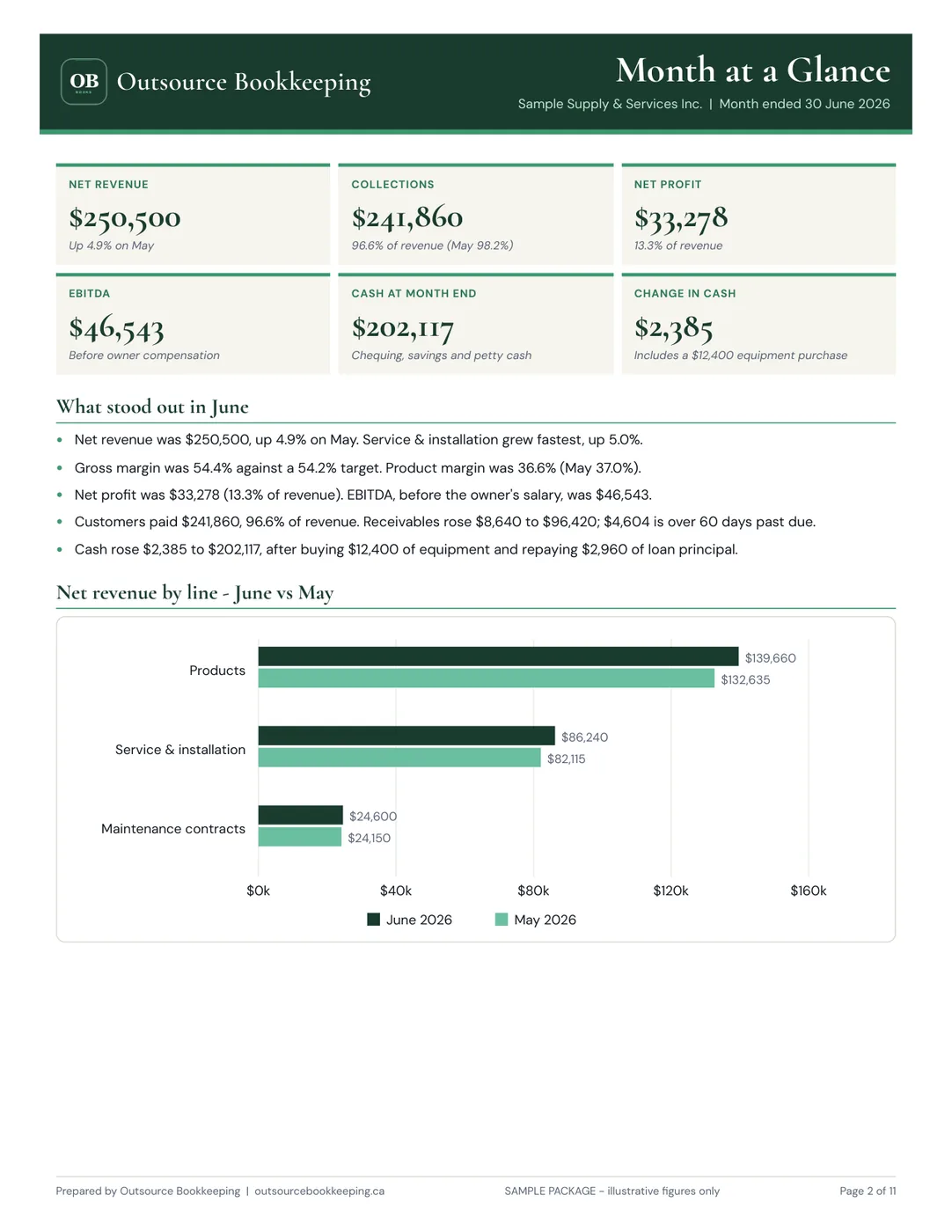
Need professional bookkeeping?
Outsource Bookkeeping delivers CRA-ready financial reports by the 10th of every month — flat rate, no surprises. See our pricing →
