
What is a Cash Flow Statement?
A cash flow statement is one of the three core financial statements every business should produce — alongside the balance sheet and income statement. While the income statement measures profitability and the balance sheet captures financial position, the cash flow statement answers the most urgent question a business owner can ask:
Where did my cash come from, and where did it go?
The cash flow statement tracks all actual cash movements in and out of your business during a specific period — typically a month, quarter, or fiscal year. It does not care about revenue you've earned but haven't collected. It does not care about expenses you've accrued but haven't paid. It only counts cash that physically moved.
For Canadian small businesses, this distinction is critical. A business that invoices aggressively but collects slowly can show healthy profits on the income statement while struggling to make payroll or pay CRA remittances. The cash flow statement reveals this gap — and it does so before you're in crisis.
Cash Flow vs. Profit: Why They're Different
This is one of the most important concepts in small business finance, and one of the most frequently misunderstood.
Profit (net income) is calculated on the accrual basis: revenue is recorded when earned (when you invoice), and expenses are recorded when incurred (when you receive the bill). The income statement can show a $30,000 profit in a month where you issued invoices worth $80,000 — even if none of those invoices have been paid yet.
Cash flow is calculated on the cash basis: only actual cash inflows and outflows are recorded.
A real-world Canadian example:
A Toronto marketing agency invoices $120,000 in Q4. Their net profit is $40,000. But three of their largest clients pay on 90-day terms, meaning most of that $120,000 won't arrive until Q1 of next year. Meanwhile, they've paid $70,000 in salaries and $8,000 in HST remittances to the CRA in Q4. Their income statement looks great. Their cash flow statement shows they're running out of cash.
This scenario — profitable but cash-poor — is one of the leading causes of small business failure in Canada. Monthly cash flow statements give you the visibility to see it coming and act before it becomes a crisis.
The Three Sections of a Cash Flow Statement
Every cash flow statement has three distinct sections. Understanding each one tells a different part of your business's financial story.
1. Operating Activities
Operating activities represent cash generated from or used by your core business operations — the day-to-day work of running your business.
Cash inflows from operating activities include: - Collections from customers (cash received, not revenue earned) - HST/GST refunds received from the CRA - Interest received on business bank accounts
Cash outflows from operating activities include: - Payments to suppliers and vendors - Payroll and payroll tax remittances (CPP, EI, income tax source deductions) - HST/GST remittances to the CRA - Rent and utilities - Loan interest payments - Income tax installments paid to the CRA
What healthy operating cash flow looks like: For a mature business, operating activities should consistently generate positive cash flow. If operating cash flow is consistently negative, the business cannot sustain itself from its own operations — it must borrow or seek equity to survive.
Canadian-specific items to watch: CRA income tax installments and HST/GST remittances are operating cash outflows that don't appear as expenses on the income statement. Many small business owners are surprised when quarterly CRA payments hit — a monthly cash flow statement prevents these surprises.
2. Investing Activities
Investing activities represent cash used to buy or sell long-term assets — things that will benefit the business for more than one year.
Cash outflows from investing activities include: - Purchasing equipment, machinery, or vehicles - Buying commercial real estate - Renovations and leasehold improvements - Purchasing investments or securities
Cash inflows from investing activities include: - Proceeds from selling equipment or property - Returns on investments
What to watch: Heavy investing outflows are not necessarily bad — they represent growth. A construction company buying a new $200,000 excavator will show a large investing outflow. But this needs to be funded by operating cash flow or financing. If a business is spending heavily on investing while operating cash flow is negative, it's depleting cash rapidly and may soon face a liquidity crisis.
In Canada, large capital purchases may qualify for accelerated CCA (Capital Cost Allowance) deductions — a tax benefit that reduces taxable income. Your bookkeeper should flag large capital purchases so your accountant can maximize these deductions.
3. Financing Activities
Financing activities represent cash from funding sources — how the business raises or repays capital.
Cash inflows from financing activities include: - Proceeds from bank loans or lines of credit - Shareholder loans advanced to the company - New equity investment (issuing shares) - Government grants received as cash
Cash outflows from financing activities include: - Loan principal repayments (not interest — that's in operating activities) - Repayment of shareholder loans - Dividends paid to shareholders - Share buybacks
What to watch: Relying heavily on financing inflows to cover operating shortfalls is a warning sign. If a business consistently needs to borrow to pay its bills, the core operations are not generating enough cash. The goal is for operating activities to fund the business, with financing used for strategic growth.
How to Read a Cash Flow Statement
When reviewing your monthly cash flow statement, follow this process:
1. Start with the bottom line: What was the net change in cash for the period? Is it positive or negative? 2. Check operating cash flow: Is your core business generating cash? This is the most important number. 3. Review investing activities: Were there significant capital purchases? Are they aligned with your growth plans? 4. Review financing activities: Is debt increasing or decreasing? Are shareholder loans growing? 5. Reconcile to bank: The ending cash balance on the cash flow statement should match your bank statement balance. If it doesn't, there's a bookkeeping error. 6. Compare to prior months: Is operating cash flow trending up, down, or flat? Trend analysis is more valuable than any single month.
Direct vs. Indirect Method
Cash flow statements can be prepared using two methods:
Direct method: Lists actual cash receipts and payments — how much cash you collected from customers, how much you paid to suppliers, etc. More intuitive to read, but requires detailed cash tracking.
Indirect method: Starts with net income and adjusts for non-cash items (depreciation, changes in working capital). This is the most common method for small businesses because it can be derived from the income statement and balance sheet.
Most Canadian small business accounting software (QuickBooks, Xero) generates the indirect method by default. The result is the same — the methods are just different paths to the same answer.
Warning Signs in a Cash Flow Statement
A monthly review of your cash flow statement can reveal problems that the income statement hides:
- ●Negative operating cash flow despite positive net income: Your customers are paying slowly. Accounts receivable is growing faster than cash collections. You need to tighten payment terms.
- ●Accounts receivable growing month-over-month: Revenue is being invoiced but not collected. This is a cash trap — especially dangerous in service businesses.
- ●HST/GST payable increasing without corresponding remittances: You're collecting HST from customers but not remitting to the CRA on time. CRA charges 6% per year interest on late remittances, plus penalties.
- ●Operating cash flow funded by financing: You're borrowing to pay operating expenses. This is unsustainable without a clear plan to restore positive operating cash flow.
- ●No cash buffer: If your ending cash balance regularly falls below 1-2 months of operating expenses, you're one bad month away from a cash crisis.
How Monthly Cash Flow Monitoring Prevents Business Failure
Canadian businesses fail for many reasons — but running out of cash is the mechanism of nearly every failure, regardless of cause.
A business that monitors its cash flow monthly — not quarterly, not annually — can:
- ●Predict cash shortfalls 60-90 days in advance and arrange financing before it becomes urgent
- ●Time large purchases around peak cash collection periods
- ●Manage CRA installment payments without surprise cash crunches
- ●Identify slow-paying clients before they become a collections problem
- ●Make hiring and expansion decisions based on real cash data, not perceived profitability
The cash flow statement, read monthly alongside the balance sheet and income statement, gives you the complete financial picture. Most small business owners who "didn't see it coming" simply weren't looking at the right data.
Getting Monthly Cash Flow Statements for Your Business
If your bookkeeper isn't delivering a cash flow statement every month alongside your P&L and balance sheet, you're missing one-third of your financial picture.
Our monthly bookkeeping service includes all three core financial statements — income statement, balance sheet, and cash flow statement — delivered by the 15th of each following month. Our financial reporting service also provides customized cash flow analysis for lenders, investors, and CRA compliance.
Managing cash flow isn't just a bookkeeping task — it requires accurate, timely books. Errors in accounts receivable, accounts payable, or HST payable all distort your cash flow statement. Clean books produce reliable cash flow data; unreliable books produce dangerous blind spots.
At Outsource Bookkeeping, we handle the complete monthly bookkeeping cycle for Canadian small businesses starting at flat rate from $500/month — including the financial statements you need to make confident decisions. Contact us to get your monthly financial package set up.
Official Sources
ROE and EI figures in this guide are sourced directly from Service Canada and the CRA, verified for 2026:
Frequently Asked Questions
See the work before you buy it
This is what lands in your inbox by the 10th.
A 11-page management package and the matching Excel workbook — your P&L against industry targets, EBITDA with owner-pay scenarios, and a cash flow written in sentences. Read the real thing, page by page.
See the full package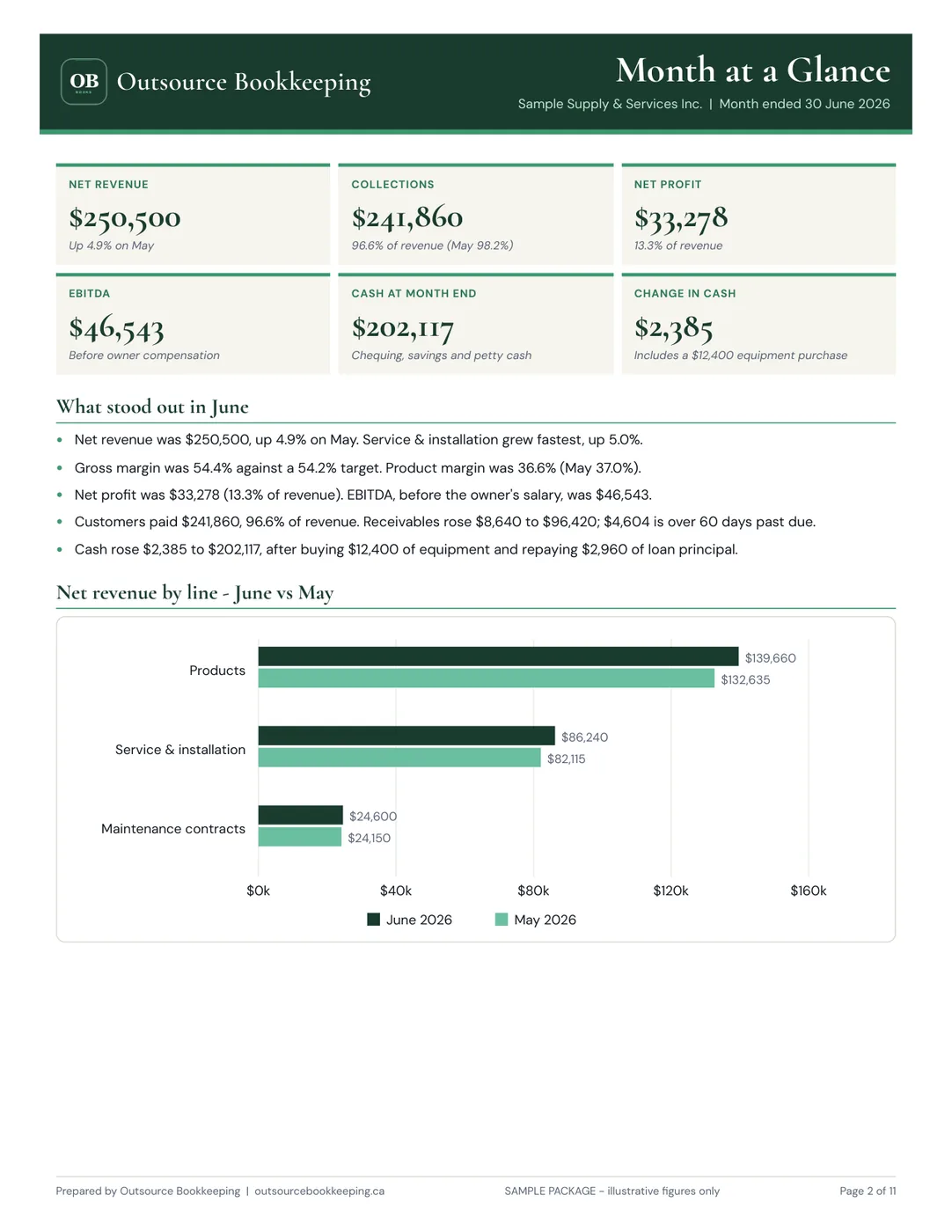
Need professional bookkeeping?
Outsource Bookkeeping delivers CRA-ready financial reports by the 10th of every month — flat rate, no surprises. See our pricing →
