
What is a Balance Sheet?
A balance sheet is one of the three core financial statements every business produces. It is a snapshot of your business's financial position at a single point in time — typically the last day of a month, quarter, or fiscal year.
Unlike the income statement (which shows revenue and expenses over a period), the balance sheet answers a single question: What does my business own, what does it owe, and what is left over for me?
For Canadian small business owners — whether you're a sole proprietor filing a T1 Business Income schedule, or an incorporated company filing a T2 — the balance sheet is not just an accounting document. It is a critical tool that your accountant uses for tax planning, that lenders review before approving loans, and that you should be reviewing every month to understand the true financial health of your business.
The Balance Sheet Equation
Every balance sheet is built around one fundamental equation:
Assets = Liabilities + Equity
This equation must always balance — which is why it's called a "balance sheet." If the two sides don't match, there is an error in your books.
Here's what each term means:
- ●Assets — everything your business owns or controls that has economic value
- ●Liabilities — everything your business owes to others
- ●Equity — the difference between the two; the owner's residual claim on the business
Example: If your business owns $150,000 in assets and owes $90,000 in liabilities, your equity is $60,000. This is the theoretical value of the business if you sold everything you own and paid off everything you owe.
Assets: What Your Business Owns
Assets are divided into two categories: current assets and long-term (non-current) assets.
Current Assets
Current assets are cash or items expected to be converted to cash within 12 months:
- ●Cash and bank balances — the most liquid asset; what's in your business bank accounts right now
- ●Accounts receivable — money your customers owe you for invoices you've sent but haven't been paid yet
- ●Inventory — goods you hold for sale (relevant for product-based businesses)
- ●Prepaid expenses — costs paid in advance, like annual insurance premiums or prepaid software subscriptions
- ●HST/GST receivable — input tax credits (ITCs) owing to you from the CRA if your ITCs exceed your HST/GST collected in a period
Long-Term Assets
Long-term assets are things your business owns that will be used over multiple years:
- ●Equipment and machinery — computers, vehicles, tools, manufacturing equipment
- ●Leasehold improvements — renovations to a space you lease
- ●Furniture and fixtures
- ●Accumulated depreciation — the portion of long-term asset value already expensed; shown as a reduction against the asset
In Canada, the CRA uses Capital Cost Allowance (CCA) classes to determine how quickly long-term assets are depreciated for tax purposes. The balance sheet shows net book value (cost minus accumulated depreciation).
Liabilities: What Your Business Owes
Like assets, liabilities are divided into current liabilities and long-term liabilities.
Current Liabilities
Current liabilities are amounts due within 12 months:
- ●Accounts payable — bills from suppliers and vendors you haven't paid yet
- ●HST/GST payable — HST or GST you've collected from customers but haven't yet remitted to the CRA. This is one of the most important line items for Canadian businesses — it's not your money, and the CRA expects it on your next filing date.
- ●Payroll liabilities — CPP, EI, and income tax deductions withheld from employees but not yet remitted to the CRA
- ●Accrued liabilities — expenses incurred but not yet invoiced (like year-end bonuses or audit fees)
- ●Current portion of long-term debt — the amount of a long-term loan due within the next 12 months
- ●Deferred revenue — payments received from customers for goods or services not yet delivered
Long-Term Liabilities
Long-term liabilities are obligations due beyond 12 months:
- ●Bank loans and lines of credit
- ●Mortgages on business property
- ●Shareholder loans — amounts owed by the corporation to its shareholders (common in Canadian owner-managed businesses)
Important for Canadian corporations: Shareholder loans that remain outstanding at the end of the fiscal year may have tax consequences under the Income Tax Act. An accountant review of your balance sheet can identify these issues before they create CRA problems.
Equity: The Owner's Stake
Equity represents the owners' claim on the business after all liabilities are paid. The components differ depending on your business structure.
Sole Proprietorship or Partnership
- ●Owner's capital — cumulative contributions made to the business
- ●Retained earnings (or owner's drawings) — accumulated profits minus any amounts withdrawn
Corporation
- ●Share capital — the amount paid for shares when the company was incorporated
- ●Retained earnings — accumulated net income since incorporation, less dividends paid
- ●Contributed surplus — additional paid-in capital beyond par value (less common for small businesses)
For Canadian owner-managed corporations, the equity section of the balance sheet tells an important story: how much profit has been retained in the company vs. paid out as salary or dividends. This affects corporate tax planning, the small business deduction, and future business sale valuations.
How to Read a Balance Sheet
When you open your monthly balance sheet, follow this sequence:
1. Check the date — confirm it reflects the period you're reviewing (e.g., "As at April 30, 2026") 2. Verify it balances — total assets must equal total liabilities plus equity 3. Review cash and bank — is your cash position consistent with what you see in your bank account? 4. Check accounts receivable — is it growing faster than revenue? Aging AR is a warning sign. 5. Review HST/GST payable — does the balance match what you expect to remit to the CRA on your next filing date? 6. Check debt levels — are loans increasing or decreasing over time? 7. Review equity — is retained earnings growing (profit being reinvested) or shrinking (losses being absorbed)?
A well-maintained balance sheet reviewed monthly catches errors, identifies cash flow risks, and gives you and your accountant the accurate data needed for tax planning.
Balance Sheet vs. Income Statement: What's the Difference?
These two statements are often confused. Here's the key distinction:
| Balance Sheet | Income Statement | |
|---|---|---|
| **What it shows** | Financial position at a point in time | Revenue and expenses over a period |
| **Time period** | A single date ("as at") | A date range ("for the period ended") |
| **Key question answered** | What do I own and owe? | Did I make a profit? |
| **Primary accounts** | Assets, liabilities, equity | Revenue, expenses, net income |
Both statements are connected: the net income from the income statement flows into retained earnings on the balance sheet at the end of each period.
Why Your Balance Sheet Matters for Canadian Tax
Your balance sheet is not just an internal management tool — it has direct tax implications:
- ●HST/GST payable must match your actual CRA remittances. Discrepancies can trigger CRA enquiries.
- ●Shareholder loans must be repaid or included in income within defined timeframes under the Income Tax Act.
- ●Capital cost allowance is calculated based on the undepreciated capital cost (UCC) of your long-term assets — a figure derived from your balance sheet.
- ●Small business deduction eligibility can be affected by associated corporations, passive investment income, and taxable capital — all balance sheet items.
- ●Business sale and valuation — if you ever sell your business, the buyer will scrutinize your balance sheet. Clean books mean a higher valuation and a smoother transaction.
A bookkeeper who delivers accurate monthly balance sheets gives your accountant the clean data they need to minimize your tax liability and keep you CRA-compliant.
Getting a Monthly Balance Sheet for Your Business
Most small business owners don't review their balance sheet monthly — not because they don't care, but because their books aren't closed monthly. If your bookkeeper isn't delivering a balance sheet, income statement, and cash flow statement every month by the 15th of the following month, you're flying blind.
Our monthly bookkeeping service includes a complete monthly financial package — balance sheet, P&L, and cash flow statement — delivered on a fixed schedule. Our financial reporting service can also provide customized reports for lenders, investors, or CRA compliance.
For more context on the full financial reporting picture, see our guide on bookkeeper vs. accountant in Canada — which explains who produces financial statements and who uses them for tax and strategy.
At Outsource Bookkeeping, we deliver accurate monthly balance sheets for Canadian small businesses starting at flat rate from $500/month — no surprises, no hourly billing. Contact us to get your books in order.
Frequently Asked Questions
See the work before you buy it
This is what lands in your inbox by the 10th.
A 11-page management package and the matching Excel workbook — your P&L against industry targets, EBITDA with owner-pay scenarios, and a cash flow written in sentences. Read the real thing, page by page.
See the full package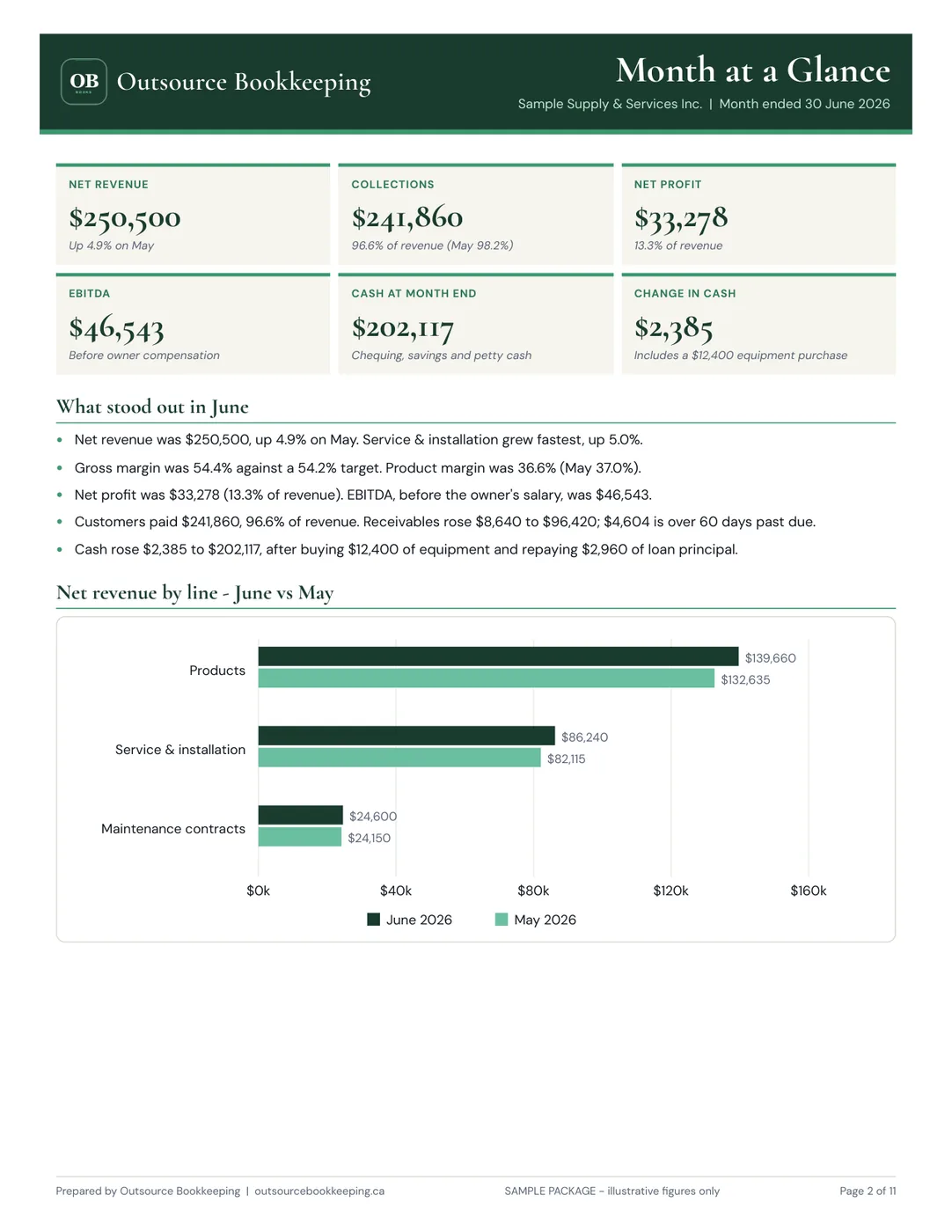
Need professional bookkeeping?
Outsource Bookkeeping delivers CRA-ready financial reports by the 10th of every month — flat rate, no surprises. See our pricing →
