
What is a Chart of Accounts?
A Chart of Accounts (CoA) is the master list of every account used in your accounting system. It is the foundational structure that determines how every financial transaction is recorded, categorized, and ultimately reported on your financial statements.
Every transaction your business makes — every sale, expense, payment, deposit — is posted to a specific account in your CoA. If your CoA is well-designed, your financial statements give you clear visibility into where money is coming from and going. If it's poorly designed, you'll have a mess that costs hundreds of dollars in accountant cleanup fees at year-end — or a full catch-up bookkeeping project to untangle.
This guide covers exactly how to set up a Chart of Accounts for a Canadian small business in 2026, with a downloadable template. If you'd rather hand the setup and the monthly upkeep to someone else, that's the core of our outsourced bookkeeping services: we build the chart once, then code every transaction to it each month.
The Five Core Account Types
Every CoA is organized around five account types, which map directly to the two main financial statements:
| Account Type | Financial Statement | Examples |
|---|---|---|
| Assets | Balance Sheet | Cash, accounts receivable, equipment, inventory |
| Liabilities | Balance Sheet | Accounts payable, GST/HST owing, loans, credit cards |
| Equity | Balance Sheet | Owner's capital, retained earnings, dividends |
| Revenue | Income Statement | Sales, service revenue, interest income |
| Expenses | Income Statement | Rent, salaries, utilities, software, advertising |
Standard Canadian Account Numbering Convention
Most Canadian small businesses use a 4-digit numbering system based on the IFRS / GIFI structure:
| Range | Account Type | Subranges |
|---|---|---|
| 1000-1999 | Assets | 1000-1099 Cash, 1100-1199 A/R, 1200-1299 Inventory, 1300-1399 Prepaid, 1500-1799 Fixed Assets |
| 2000-2999 | Liabilities | 2000-2099 A/P, 2100-2199 Credit Cards, 2200-2299 Tax Liabilities, 2300-2399 Payroll Liabilities, 2500-2999 Loans |
| 3000-3999 | Equity | 3000 Common Shares, 3100 Retained Earnings, 3200 Dividends |
| 4000-4999 | Revenue | 4000-4099 Sales, 4100-4199 Service Revenue, 4500 Other Income |
| 5000-5999 | Cost of Goods Sold | 5000 Materials, 5100 Direct Labour, 5200 Subcontractors |
| 6000-6999 | Operating Expenses | Rent, salaries, utilities, marketing, software |
| 7000-7999 | Other Income | Interest income, foreign exchange gain |
| 8000-8999 | Other Expenses | Interest expense, foreign exchange loss |
| 9000-9999 | Income Tax Expense | Corporate income tax, deferred tax |
The numbers don't matter to CRA — they matter for you and your accountant. Consistent numbering makes the books readable.
A Sample Canadian Small Business Chart of Accounts
Below is a starter CoA for a typical Canadian service business (consulting, agency, professional services). Adapt as needed.
Assets (1000-1999)
- ●1000 — Operating Bank Account (CAD)
- ●1010 — Savings Account
- ●1020 — USD Bank Account
- ●1050 — Petty Cash
- ●1100 — Accounts Receivable
- ●1150 — Allowance for Doubtful Accounts
- ●1200 — Inventory (if applicable)
- ●1300 — Prepaid Expenses
- ●1310 — Prepaid Insurance
- ●1400 — Refundable GST/HST (ITC)
- ●1500 — Computer Equipment
- ●1510 — Accumulated Depreciation — Computer Equipment
- ●1600 — Office Furniture & Equipment
- ●1610 — Accumulated Depreciation — Furniture
- ●1700 — Vehicles
- ●1710 — Accumulated Depreciation — Vehicles
Liabilities (2000-2999)
- ●2000 — Accounts Payable
- ●2100 — Visa / Credit Card
- ●2110 — Mastercard
- ●2200 — GST/HST Payable
- ●2210 — GST/HST Owing (Net)
- ●2220 — Provincial Sales Tax Payable (PST/QST/RST)
- ●2300 — CPP Payable
- ●2310 — EI Payable
- ●2320 — Federal Income Tax Withheld
- ●2330 — Provincial Income Tax Withheld
- ●2340 — WCB / WSIB Payable
- ●2350 — Vacation Pay Payable
- ●2400 — Salaries & Wages Payable
- ●2500 — Shareholder Loans
- ●2600 — Bank Loans Payable
- ●2700 — Deferred Revenue (customer deposits)
Equity (3000-3999)
- ●3000 — Common Shares
- ●3100 — Retained Earnings
- ●3200 — Dividends Declared
- ●3300 — Owner's Capital (sole prop)
- ●3310 — Owner's Draws (sole prop)
Revenue (4000-4999)
- ●4000 — Sales — Service A
- ●4010 — Sales — Service B
- ●4020 — Sales — Product Sales
- ●4100 — Consulting Revenue
- ●4500 — Late Payment Fees
- ●4900 — Sales Discounts (contra-revenue)
Cost of Goods Sold (5000-5999)
- ●5000 — Materials
- ●5100 — Direct Labour
- ●5200 — Subcontractor Costs
- ●5300 — Shipping & Freight In
- ●5500 — Inventory Adjustments
Operating Expenses (6000-6999)
- ●6000 — Salaries & Wages
- ●6010 — CPP Expense (employer)
- ●6020 — EI Expense (employer)
- ●6030 — Vacation Pay Expense
- ●6040 — Employer Health Tax (EHT)
- ●6050 — WCB / WSIB Premiums
- ●6060 — Employee Benefits
- ●6100 — Rent
- ●6110 — Utilities
- ●6120 — Internet & Phone
- ●6200 — Office Supplies
- ●6210 — Software Subscriptions
- ●6220 — Computer Hardware (under $500)
- ●6300 — Advertising & Marketing
- ●6310 — Website Hosting
- ●6320 — Professional Memberships
- ●6400 — Professional Fees — Accounting
- ●6410 — Professional Fees — Legal
- ●6420 — Bookkeeping Fees
- ●6500 — Travel
- ●6510 — Meals & Entertainment (50% deductible)
- ●6520 — Vehicle — Fuel
- ●6530 — Vehicle — Repairs
- ●6540 — Vehicle — Insurance
- ●6600 — Insurance — Business
- ●6700 — Bank Fees
- ●6710 — Credit Card Processing Fees
- ●6720 — Interest Expense (operating)
- ●6800 — Depreciation Expense
- ●6900 — Bad Debts Expense
Other Income / Other Expenses (7000-8999)
- ●7000 — Interest Income
- ●7100 — Foreign Exchange Gain
- ●8000 — Interest Expense (long-term debt)
- ●8100 — Foreign Exchange Loss
Income Tax (9000-9999)
- ●9000 — Corporate Income Tax Expense — Federal
- ●9100 — Corporate Income Tax Expense — Provincial
How to Customize Your Chart of Accounts
A good CoA balances detail (so reports are useful) with simplicity (so data entry is consistent). General principles:
- ●Group similar expenses. Don't create separate accounts for "Office Pens" and "Office Paper" — both go in "Office Supplies."
- ●Split expenses that have different tax treatments. Meals & Entertainment is 50% deductible — it must be its own account.
- ●Track revenue by product line, not by customer. Customers belong in your CRM; revenue lines belong in the CoA.
- ●Use sub-accounts for legal/regulatory tracking. Vehicle expenses, payroll deductions, and GST/HST need granular tracking for CRA.
- ●Don't over-engineer. Start lean and add accounts as a real need emerges.
GST/HST Setup in the Chart of Accounts
For HST/GST-registered Canadian businesses, set up these three accounts:
- ●2200 — GST/HST Payable: Liability account. Increases when you collect HST on sales. Decreases when you remit to CRA.
- ●1400 — Refundable GST/HST (ITC): Asset account. Increases when you pay HST on business expenses (Input Tax Credits). Decreases when you remit to CRA.
- ●2210 — GST/HST Owing (Net): Net of the above two. This is what you actually pay to CRA.
QuickBooks and Xero automate this if you enable GST/HST tracking on the company file. If your software doesn't handle it, your bookkeeper should reconcile these accounts every filing period — see our HST Filing Deadlines guide for filing details.
Mapping Your CoA to GIFI Codes (T2 Tax Filing)
For corporate tax (T2), CRA requires that your financial data be reported using GIFI (General Index of Financial Information) codes. GIFI is essentially a standardized chart of accounts CRA uses to read your financials.
Modern accounting software (QuickBooks, Xero) handles GIFI mapping automatically — every account in your CoA is tagged with a GIFI code. When your accountant prepares the T2, they use the GIFI report rather than your CoA directly.
If you're using a non-Canadian or generic accounting software, talk to your accountant about manual GIFI mapping at year-end.
Common Chart of Accounts Mistakes
1. Using a generic US template. Most templates from US sources don't account for HST/GST, EHT, vacation pay, or GIFI mapping. 2. Too many accounts. A 200-account CoA in a small business creates inconsistent data entry — different people categorize the same expense to different accounts. 3. Too few accounts. A 15-account CoA buries everything in "General Expenses" and loses all visibility. 4. Mixing personal and business accounts. Personal vehicle gas, personal meals, owner's groceries — these need to go to a "Shareholder Loan" or "Owner's Draw" account, not to expenses. 5. Not separating Meals (50% deductible) from Entertainment events. CRA treats them differently. 6. Skipping HST/GST accounts entirely. Without these, your HST returns require manual reconstruction every quarter.
How Outsource Bookkeeping Sets Up Your CoA
For new clients, the first thing we do is review and rebuild your Chart of Accounts to match your industry, your reporting needs, and your tax obligations. We:
1. Map your existing accounts to a clean Canadian CoA structure 2. Set up GST/HST tracking with proper account flows 3. Configure GIFI codes for T2 tax filing 4. Add industry-specific accounts (e.g., construction job costing, medical OHIP reconciliation) 5. Document the CoA so any future bookkeeper can pick it up cleanly
CoA setup is included when you start on our flat-rate monthly bookkeeping service — every account reconciled monthly, HST/GST tracked properly, and CRA-ready reports by the 10th. See our bookkeeping pricing for what the $500/month covers, or book a free 15-minute call to get a clean, CRA-ready Chart of Accounts.
Related Resources
Frequently Asked Questions
See the work before you buy it
This is what lands in your inbox by the 10th.
A 11-page management package and the matching Excel workbook — your P&L against industry targets, EBITDA with owner-pay scenarios, and a cash flow written in sentences. Read the real thing, page by page.
See the full package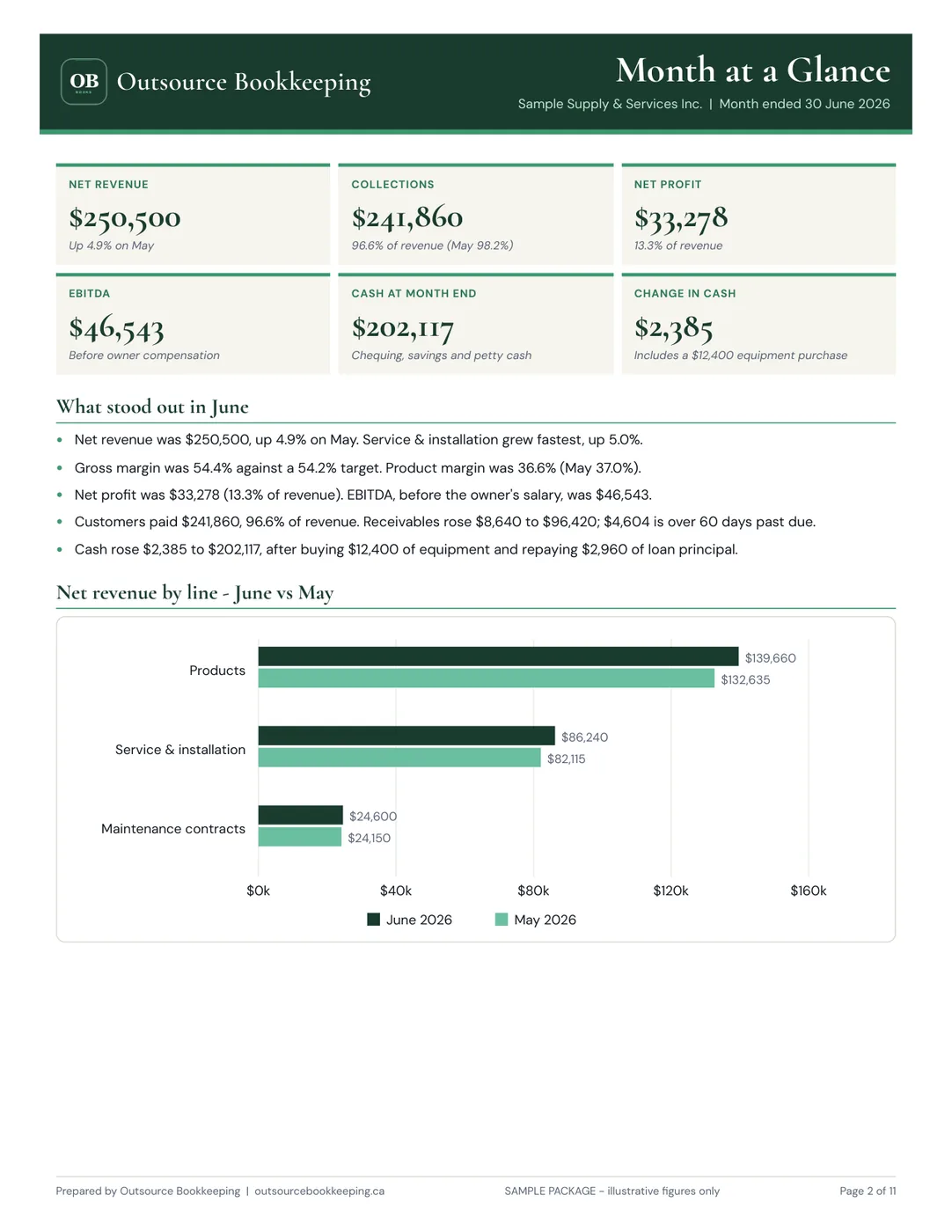
Need professional bookkeeping?
Outsource Bookkeeping delivers CRA-ready financial reports by the 10th of every month — flat rate, no surprises. See our pricing →
