
Tax Season 2026: Complete Checklist for Canadian Small Business Owners
Tax season in Canada is not a single deadline — it's a series of filing obligations that run from January through June. Missing any one of them triggers CRA penalties that compound fast. This guide covers every key deadline and action item for Canadian small businesses with a December 31 year-end.
---
2026 Key Tax Deadlines at a Glance
| Obligation | Deadline | Who It Applies To |
|---|---|---|
| T4 slips to employees + CRA | Feb 28, 2026 | Any business with employees |
| T5018 (subcontractor payments) | Feb 28, 2026 | Construction businesses |
| Corporate tax balance owing (T2) | Mar 31, 2026 (most CCPCs) / Mar 2, 2026 (other corps) | Dec 31 year-end corporations |
| HST Q4 2025 (Oct–Dec) | Feb 28, 2026 | Quarterly HST filers |
| Personal tax (T1) filing | Apr 30, 2026 | Sole proprietors, all individuals |
| Self-employed T1 filing | Jun 15, 2026 | Self-employed individuals |
| Corporate tax return (T2) | Jun 30, 2026 | Dec 31 year-end corporations |
| HST annual filing | Jun 15, 2026 | Annual HST filers (Dec year-end) |
> Important: Even if you have until June 30 to file your T2, any tax balance owing is due earlier — 3 months after year-end (March 31) for most small CCPCs that claim the small business deduction, or 2 months for other corporations. Filing late does not extend your payment deadline.
---
Step-by-Step Tax Season Checklist
January — Get Organized
Bank & Credit Card Reconciliation - Reconcile every bank account for all 12 months of 2025 - Reconcile every credit card statement through December 31 - Ensure no unclassified transactions remain in your bookkeeping software - Download year-end bank statements (PDF) for all accounts
Payroll Records - Confirm total payroll remittances made to CRA match your payroll records - Verify employee information (SINs, addresses) is current - Calculate T4 box amounts (employment income, CPP, EI, income tax) - Prepare T4 slips in CRA My Business Account or payroll software
HST Reconciliation - Confirm HST collected vs. filed matches for every filing period in 2025 - Ensure all Input Tax Credits (ITCs) are properly claimed - Review any Q4 2025 HST owing and flag for Feb 28 payment
---
February — File Payroll & Prepare Year-End Package
By February 28: - Distribute T4 slips to all employees - File T4 Summary with CRA (via My Business Account or paper) - File T5018 if you paid subcontractors $500+ in 2025 (construction businesses) - Pay any T2 corporate tax balance owing (December year-end corps) - File and pay Q4 2025 HST return (quarterly filers)
Year-End Bookkeeping Close: - Enter all December 31 adjusting entries - Record year-end inventory count (if applicable) - Record amortization/depreciation for the year - Confirm all accounts payable and receivable balances are accurate - Generate and review: Profit & Loss Statement, Balance Sheet, A/R Aging, A/P Aging
---
March & April — Accountant Handoff
Send your accountant: - Finalized QuickBooks Online or Xero file (or year-end export) - Bank statements for all accounts (Jan–Dec 2025) - Credit card statements (Jan–Dec 2025) - HST filing confirmations for all 2025 periods - Payroll register and T4 summary - Shareholder loan continuity schedule - Capital asset additions and disposals in 2025 - Any new loan or lease agreements signed in 2025 - Prior year T2 return for reference
At Outsource Bookkeeping, we prepare and deliver a complete CRA-ready year-end package by February 10. Your accountant gets everything they need — organized, reconciled, and ready to file. No chasing bank statements or re-doing your books.
---
May & June — File Returns
Personal Tax (T1): - File T1 by April 30 (or June 15 if self-employed) - Include all T4s, investment income, rental income, and business income - Pay any balance owing by April 30 even if filing by June 15
Corporate Tax (T2): - T2 must be filed within 6 months of fiscal year-end (June 30 for Dec year-ends) - Pay balance owing by 3 months after year-end for most small CCPCs claiming the small business deduction (March 31 for Dec year-ends); 2 months for other corporations - Request a refund if overpaid — CRA typically processes within 2-4 weeks if filed electronically
---
Common Tax Season Mistakes That Trigger CRA Audits
1. Shareholder Loan Imbalance — If a shareholder withdraws more than they deposit, the excess is typically taxable income. CRA looks closely at shareholder loan accounts.
2. Personal Expenses Claimed as Business — Vehicle, meals, and entertainment are the top areas CRA targets. Keep mileage logs and retain all receipts.
3. HST on Employment Benefits — Taxable benefits provided to employees often have HST implications that get missed. Your bookkeeper should flag these throughout the year.
4. Missing T4As — If you pay contractors or professionals $500+ in a year, you may need to file T4A slips. Frequently missed by small businesses.
5. Late HST Filing — CRA's late-filing penalty is 1% of the amount owing, plus 25% of that 1% for each complete month the return is late (to a maximum of 12 months), plus compounding daily interest. Quarterly filers should set calendar reminders for each deadline.
---
How Outsource Bookkeeping Handles Tax Season For You
When you are a client, you do not manage this checklist — we do.
Every December, we begin your year-end close process. By February 10, your accountant receives a complete package including reconciled statements, HST summary, payroll records, and a financial review. Everything in one place, on time.
Your accountant can focus on tax strategy instead of fixing your books — which typically reduces your accounting fees significantly.
Book a free consultation to get set up before next tax season.
Frequently Asked Questions
See the work before you buy it
This is what lands in your inbox by the 10th.
A 11-page management package and the matching Excel workbook — your P&L against industry targets, EBITDA with owner-pay scenarios, and a cash flow written in sentences. Read the real thing, page by page.
See the full package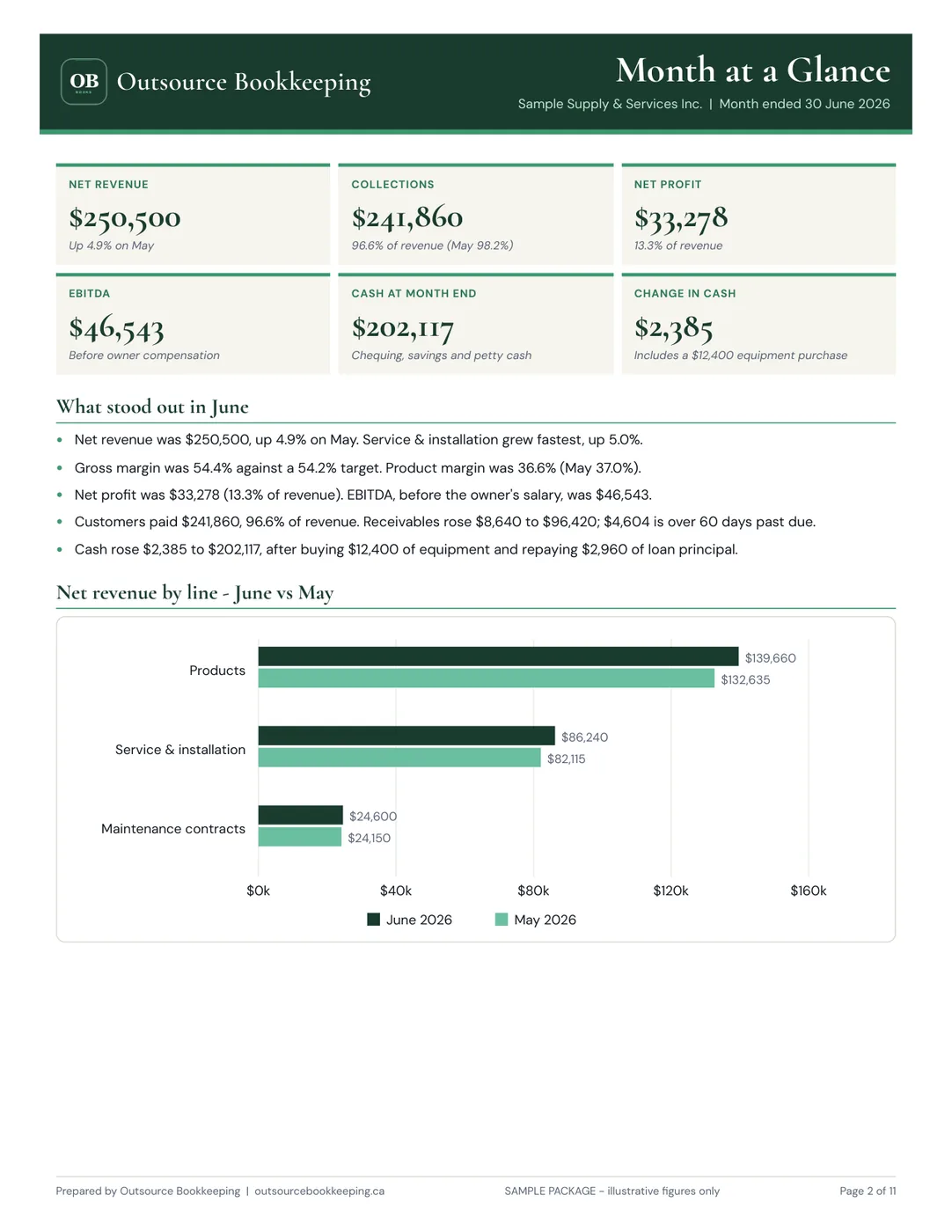
Need professional bookkeeping?
Outsource Bookkeeping delivers CRA-ready financial reports by the 10th of every month — flat rate, no surprises. See our pricing →
