
Real Estate Agents Are Running a Business — Whether They Think So or Not
Most Canadian real estate agents are self-employed independent contractors working under a brokerage. You receive commissions, not a T4 salary. You're responsible for your own CPP contributions, your own HST remittances, and your own quarterly tax installments.
That means proper bookkeeping isn't optional — it's the foundation of staying CRA-compliant, minimizing your tax bill, and understanding whether your business is actually profitable.
This guide covers everything Canadian realtors need to know about bookkeeping: commission tracking, HST, deductible expenses, and what to do if you're incorporated.
Self-Employment Status: What It Means for Your Books
As a self-employed agent, you report income on Form T2125 (Statement of Business or Professional Activities) with your T1 personal income tax return each year. There is no tax withheld at source — you must either pay quarterly tax installments or a lump sum at tax time.
Key implications: - You owe both the employee and employer portions of CPP (approximately 10.9% of net self-employment income up to the annual maximum) - No EI coverage unless you've opted in voluntarily - You must track all income and expenses throughout the year — CRA does not accept year-end estimates
If you've incorporated a Professional Corporation (PC), you file a T2 corporate return instead. This guide focuses on sole proprietors, but the expense categories apply equally to incorporated agents.
Tracking Commission Income
Commission income is the core of your bookkeeping. Each transaction closes with a commission statement from your brokerage showing:
- ●Gross commission earned on the transaction
- ●Brokerage split or franchise fee deducted
- ●Net commission paid to you
- ●HST collected (if you are HST-registered) and remitted on your behalf or separately
Your bookkeeper records each commission when received (or when earned, if you use accrual accounting — though most agents use cash basis). Every transaction needs its own line in your books, linked to the brokerage statement as source documentation.
Referral income and referral fees are treated separately: referral fees you receive from other agents are taxable income; referral fees you pay to other agents are a deductible expense.
HST Registration: When and How It Works
Once your commission income exceeds $30,000 in any single calendar quarter or across four consecutive calendar quarters, you must register for HST/GST with CRA. Most full-time agents reach this threshold within their first or second year.
What HST Registration Means for Realtors
- ●You charge HST on your commissions. In Ontario, that's 13%. In Alberta, 5% GST only. In Nova Scotia, 14%. In New Brunswick, Newfoundland, and PEI, 15%.
- ●Your brokerage may collect and remit HST on your behalf as part of their commission payout process — confirm this arrangement in writing
- ●You file HST returns with CRA (quarterly for most agents) and remit the net HST owing
- ●You can claim Input Tax Credits (ITCs) for HST paid on your business expenses — effectively recovering 5–15% of your business costs
Your HST/GST filing must accurately track both HST collected on commissions and ITCs on business purchases. This is one of the most common areas where unrepresented realtors make costly errors.
HST Does NOT Apply to Most Home Sales
Note the distinction: HST applies to your commission, not to the sale of a used residential property (which is HST-exempt). New home construction and commercial property sales may attract HST on the sale price — but that's the vendor's obligation, not yours as the agent.
Deductible Expenses for Canadian Real Estate Agents
Proper expense tracking is where bookkeeping pays for itself. Every dollar of legitimate deductions reduces your taxable income.
Vehicle Expenses
Showing properties, travelling to listings, meeting clients — vehicle use is one of your largest expenses. You can claim:
- ●Fuel and oil
- ●Insurance
- ●Repairs and maintenance
- ●Lease payments (up to CRA prescribed limits per year)
- ●CCA (Capital Cost Allowance) on a purchased vehicle
The critical requirement: You must keep a mileage log recording the date, destination, business purpose, and kilometres driven for every business trip. CRA can disallow your entire vehicle claim on audit if you have no log. Use a mileage tracking app (MileIQ, Driversnote) to automate this throughout the year.
The deductible percentage = (business kilometres ÷ total kilometres driven) × total vehicle expenses.
Home Office Expenses
If you work primarily from home — as most realtors do — you can deduct a proportional share of:
- ●Rent or mortgage interest (not principal)
- ●Property taxes
- ●Utilities (heat, hydro)
- ●Internet service
- ●Home insurance
Deductible percentage = home office square footage ÷ total home square footage. CRA Form T2125 includes a dedicated home office expense section.
Professional Fees and Memberships
- ●CREA (Canadian Real Estate Association) annual dues
- ●Provincial board fees (OREA, BCREA, CREB, RECA, etc.)
- ●Local board and MLS system fees
- ●E&O (Errors & Omissions) insurance premiums
- ●Legal fees related to business matters
Marketing and Advertising
Marketing is a major ongoing expense for realtors and is fully deductible:
- ●Photography and videography for listings
- ●Staging costs (deducted as an expense or amortized over multiple years)
- ●Digital advertising (Google, Facebook, Instagram, real estate portals)
- ●Website hosting and design fees
- ●Print materials (flyers, brochures, signage, business cards)
- ●CRM and lead management software
Technology and Software
- ●CRM platform subscriptions
- ●DocuSign or other e-signature tools
- ●Transaction management software
- ●Business portion of your mobile phone bill
- ●Computer equipment (claimed as CCA over time, or fully expensed under the Immediate Expensing incentive for eligible assets)
Brokerage Fees
Monthly desk fees, per-transaction fees, and franchise fees charged by your brokerage are deductible as a cost of earning income.
Professional Corporation Considerations
High-earning real estate agents — typically those netting $150,000 or more in annual commissions — often benefit from incorporating a Professional Corporation (where provincial legislation allows). Key advantages:
- ●Tax deferral: Corporate tax rates (approximately 11–15% on active business income) are much lower than personal marginal rates (up to 53.5% in Ontario). Income left inside the corporation is taxed at the lower rate.
- ●Income splitting: Within prescribed limits, salary or dividends can be paid to a spouse or adult children who are shareholders.
- ●Retirement planning: Retained earnings in the corporation can be invested or used to fund a pension plan.
If you are incorporated, your bookkeeping needs expand significantly: you need corporate-level books, a separate payroll record if you pay yourself a salary, dividend documentation, and a T2 corporate return filed by your accountant. See our monthly bookkeeping service for incorporated professionals.
Managing Seasonal Cash Flow
Real estate commission income is notoriously variable. Spring and fall markets are busy; January and August can be slow. Your books need to support cash flow planning during quiet months.
Practical practices:
- ●Maintain a dedicated business bank account — never mix personal and business transactions
- ●Set aside 25–35% of each commission for income tax and CPP at the time of receipt
- ●If HST-registered, set aside all HST collected in a separate account — it is never your money
- ●Track pending transactions (firm sales not yet closed) separately from received commissions
- ●Review your monthly financial reports to understand seasonal patterns and plan working capital accordingly
CRA Record-Keeping Requirements
CRA requires you to retain all business records for at least six years from the end of the last tax year they relate to. For realtors, this means:
- ●Commission statements from your brokerage for every transaction
- ●All expense receipts (receipts under $30 still require documentation for HST purposes)
- ●Mileage logs covering the full calendar year
- ●Bank and credit card statements
- ●HST return filings and CRA correspondence
- ●Any client contracts or listing agreements relevant to income
Cloud accounting software — QuickBooks Online or Xero — creates a complete, searchable, CRA-ready audit trail. Your bookkeeper maintains this throughout the year so you're never scrambling at tax time.
Year-End Preparation for Your accountant
A clean year-end package saves significant accounting fees. At December 31 (or your fiscal year-end), your bookkeeper should prepare:
- ●Final bank and credit card reconciliations
- ●Full T2125 expense summary by category
- ●Vehicle log summary with business-use percentage
- ●Home office expense calculation
- ●HST annual reconciliation (for HST-registered agents)
- ●Fixed asset schedule (CCA for vehicle, computer equipment)
- ●Shareholder loan reconciliation (if incorporated)
See our guide to bookkeeping vs. accounting in Canada to understand which tasks belong to your bookkeeper and which to your accountant.
The Cost of DIY Bookkeeping for Realtors
Many realtors attempt to manage their own books — until they can't. Common consequences:
- ●Missed HST deadlines — penalties of 1% plus 0.25% per month on the balance owing
- ●Disallowed vehicle claims — no mileage log means no deduction
- ●CRA audit — inconsistent reporting of commission income triggers attention
- ●High accounting fees — your accountant charging $150–$300/hour to clean up a year of disorganized records
- ●Overpaid taxes — missed ITCs and deductions you didn't know you could claim
A professional bookkeeper at $500/month is cheaper than a single CRA penalty or an accountant cleanup bill. See our full analysis: how much does bookkeeping cost in Canada?
Summary: What Realtor Bookkeeping Includes Every Month
- ●Record all commission income from brokerage statements
- ●Categorize and record all business expenses with receipts
- ●Reconcile business bank account and credit card statements
- ●Track HST collected and ITCs for quarterly remittance
- ●Update mileage log and calculate business-use percentage
- ●Prepare month-end P&L showing year-to-date profitability
- ●Flag any CRA filing deadlines coming up
Book a free consultation to learn how Outsource Bookkeeping handles all of this for Canadian real estate agents at a flat rate from $500/month — CRA-ready reports delivered by the 10th of every month.
Related: Small Business Tax Deductions in Canada → Related: Bookkeeping for Property Management in Canada → Related: How Much Does Bookkeeping Cost in Canada? →
Frequently Asked Questions
See the work before you buy it
This is what lands in your inbox by the 10th.
A 11-page management package and the matching Excel workbook — your P&L against industry targets, EBITDA with owner-pay scenarios, and a cash flow written in sentences. Read the real thing, page by page.
See the full package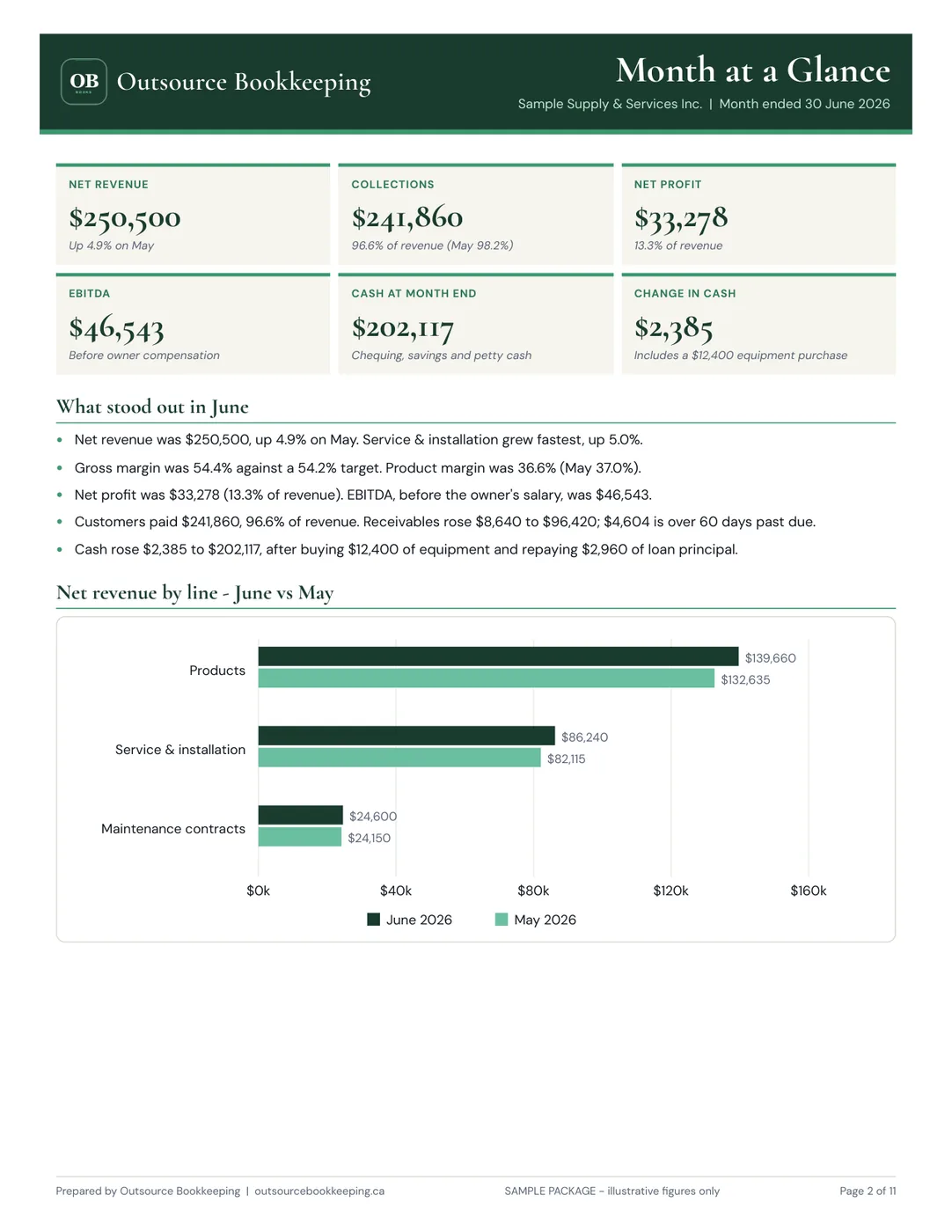
Need professional bookkeeping?
Outsource Bookkeeping delivers CRA-ready financial reports by the 10th of every month — flat rate, no surprises. See our pricing →
