
How Is Nonprofit Bookkeeping Different in Canada?
Nonprofit organizations in Canada — including registered charities, non-share capital corporations, and unincorporated associations — follow different accounting principles than for-profit businesses:
Fund accounting: Revenue and expenses are tracked by fund — restricted funds (donations for specific purposes) are kept separate from unrestricted operating funds. You cannot use restricted funds for general operations without donor permission.
No equity: Instead of shareholders' equity, nonprofits have net assets — the difference between assets and liabilities, categorized as restricted or unrestricted.
No profit motive: The goal is not profit but mission delivery. Surplus is reinvested into programs; deficits signal financial stress.
T3010 compliance: Registered charities must file the T3010 Registered Charity Information Return every year with CRA — a detailed report that is publicly available on CRA's website.
---
The T3010: Canada's Annual Charity Filing
The T3010 is the most critical compliance document for Canadian registered charities.
Due date: 6 months after your fiscal year-end - December 31 year-end → T3010 due June 30 - March 31 year-end → T3010 due September 30
What the T3010 reports: - Total revenues (donations, grants, fundraising, other) - Total expenditures (programs, management, fundraising) - Assets and liabilities at year-end - Description of charitable activities and programs - Compensation paid to directors, trustees, and top 10 earners - Political activities (must be limited) - Gifts to qualified donees (other charities)
Consequences of non-filing: CRA will revoke your registered charity status — meaning donors can no longer claim tax credits for donations, and you lose access to HST exemptions and PSB rebates. Reinstatement requires a formal application and may take months.
---
Key Nonprofit Bookkeeping Accounts
| Account | Description |
|---|---|
| Restricted Funds | Donations designated for a specific purpose by the donor |
| Unrestricted Funds | General operating donations and revenue |
| Deferred Revenue | Grants received but not yet earned (activity not yet completed) |
| Donated Goods & Services | In-kind donations (valued at fair market value) |
| Program Expenses | Direct costs of charitable programs and services |
| Management & Admin | Overhead: salaries, rent, accounting, insurance |
| Fundraising Expenses | Costs directly related to fundraising activities |
| Net Assets — Restricted | Accumulated restricted funds (not yet spent) |
| Net Assets — Unrestricted | Accumulated general reserves |
---
HST for Nonprofits in Canada
HST rules for nonprofits are more complex than for regular businesses:
Registration threshold: Nonprofits must register for HST/GST when their taxable revenues exceed $50,000/year (not the $30,000 threshold that applies to for-profit businesses).
Public Service Body (PSB) Rebate: Most qualifying nonprofits and charities are eligible for a PSB rebate — a refund of 50% of the HST paid on eligible purchases (the rebate percentage varies by province and organization type). This is a significant benefit that many nonprofits miss.
Exempt supplies: Many nonprofit activities are HST-exempt — including most membership fees, admission to certain events, and supplies made substantially to members. Proper categorization is essential to correctly calculate HST obligations.
Practical tip: A bookkeeper with nonprofit HST experience ensures you are claiming the full PSB rebate and correctly categorizing exempt vs. taxable activities.
---
Donation Receipts: CRA Requirements
Registered charities can issue official donation receipts — which donors use to claim tax credits on their T1 returns. The receipt must contain all of the following to be valid:
1. Your charity's legal name 2. Your CRA Registered Charity number (15 digits) 3. The donor's full name and address 4. The date the donation was received 5. The amount of the gift 6. The eligible amount for tax purposes (total gift minus any advantage received by the donor) 7. A statement that it is an official receipt for income tax purposes 8. The serial number of the receipt 9. The date the receipt was issued 10. Location where the receipt was issued 11. Signature of an authorized official
Missing any element makes the receipt invalid — CRA will reject it during audit, and the donor loses the tax credit.
---
Best Bookkeeping Software for Canadian Nonprofits
| Software | Best For | Monthly Cost |
|---|---|---|
| QuickBooks Online | Small-medium nonprofits, widely used by Canadian accountants | $30–$90/month |
| Sage Intacct | Larger nonprofits with complex fund accounting needs | Custom pricing |
| Aplos | Nonprofits and churches, built-in fund accounting | $59–$159/month |
| Wave | Very small nonprofits with basic needs (free) | Free |
For most small Canadian nonprofits, QuickBooks Online with proper chart of accounts setup handles fund accounting well. Your bookkeeper can set up restricted fund classes and run fund-specific reports.
---
Should a Nonprofit Outsource Bookkeeping?
Yes — especially for nonprofits without in-house finance staff (which is most nonprofits under $1M in annual revenue).
Outsourcing bookkeeping to a professional service provides: - T3010 preparation support — accurate revenue/expense reporting for the annual return - Fund accounting accuracy — restricted vs. unrestricted funds properly segregated - HST PSB rebate claims — ensuring you claim every eligible rebate - Donation receipt compliance — all required elements included - CRA-ready financials — for your external auditor or reviewer
At flat rate from $500/month, Outsource Bookkeeping provides professional nonprofit bookkeeping at a fraction of the cost of a part-time in-house finance employee.
Book a free consultation → to discuss your nonprofit's bookkeeping needs.
Related: CRA Bookkeeping Requirements in Canada → Related: Bookkeeping for Small Business in Canada →
Frequently Asked Questions
See the work before you buy it
This is what lands in your inbox by the 10th.
A 11-page management package and the matching Excel workbook — your P&L against industry targets, EBITDA with owner-pay scenarios, and a cash flow written in sentences. Read the real thing, page by page.
See the full package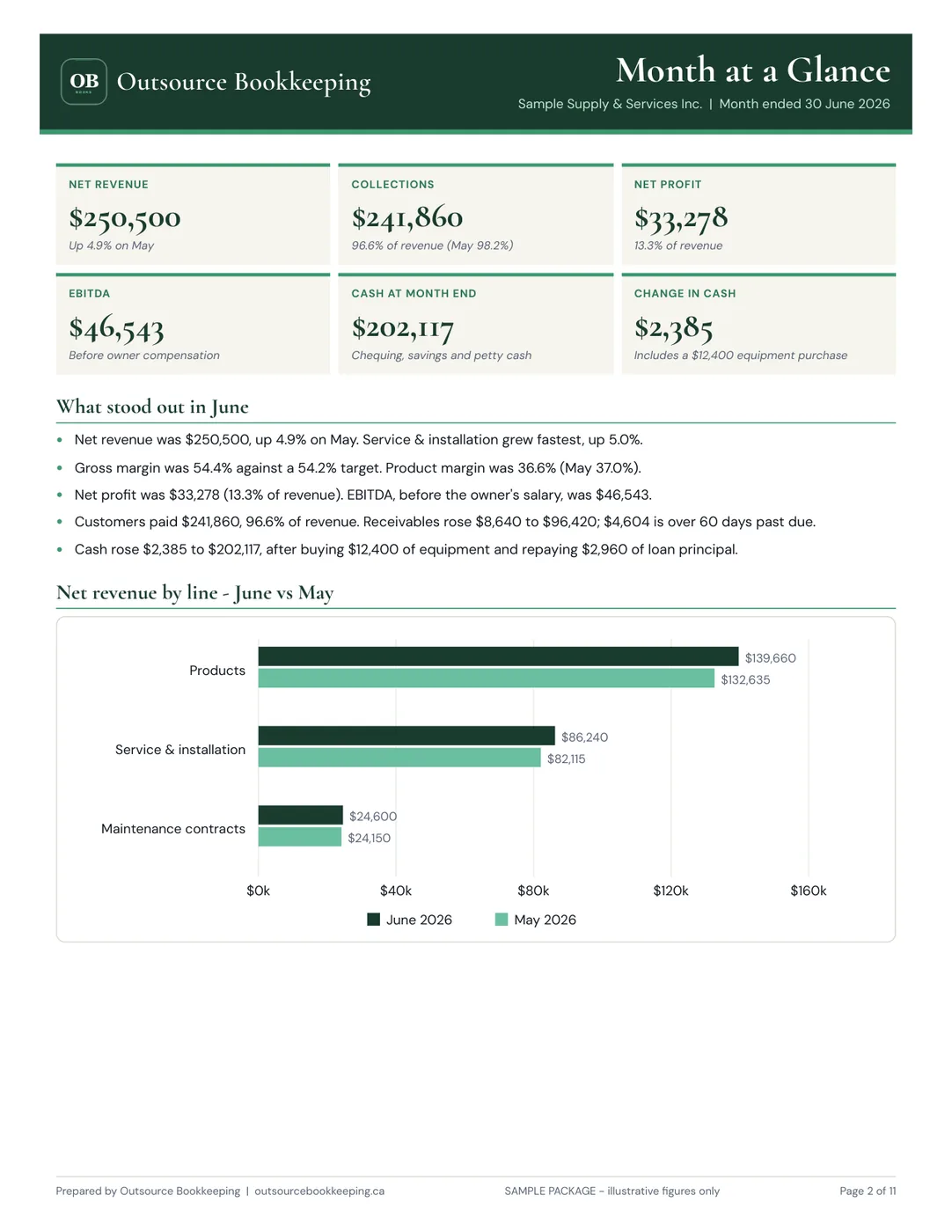
Need professional bookkeeping?
Outsource Bookkeeping delivers CRA-ready financial reports by the 10th of every month — flat rate, no surprises. See our pricing →
