
Bookkeeping for Canadian Freelancers: A Complete Guide
Whether you're a graphic designer, web developer, consultant, writer, photographer, or any other type of independent professional, one thing is certain: once you're self-employed in Canada, you're also running a business — and that means bookkeeping.
For many freelancers, the financial side of their business is the most stressful part. CRA requirements, HST registration, quarterly tax installments, expense tracking — it can feel overwhelming. This guide breaks it all down into clear, actionable steps.
Why Bookkeeping Matters for Canadian Freelancers
CRA requires every self-employed Canadian to report their income accurately and maintain supporting records for 6 years. Beyond compliance, good bookkeeping helps you:
- ●Pay less tax — by claiming every legitimate deduction
- ●Avoid surprises at tax time — knowing your net income throughout the year
- ●Manage cash flow — especially important when income is irregular
- ●Get a mortgage or loan — lenders want to see organized financial records
- ●Grow your business — understanding which clients and projects are most profitable
Step 1: Separate Your Business and Personal Finances
The single most important thing any freelancer can do for their bookkeeping is open a separate business bank account and business credit card immediately.
When personal and business transactions are mixed, every transaction requires investigation to determine if it's deductible. With separate accounts, your business transactions are immediately identifiable — making bookkeeping dramatically faster and simpler.
This separation also demonstrates to CRA that you operate a legitimate business, not a hobby.
Step 2: Track All Income
Every dollar you earn as a freelancer must be tracked, regardless of how it was paid:
- ●Direct deposits from clients — recorded in your bank account
- ●Cheques — record when received, not when deposited
- ●PayPal, Stripe, Interac e-Transfer — export statements and reconcile monthly
- ●Cash payments — record every cash receipt immediately
- ●Income in kind — if a client pays you with goods or services, this still counts as income at fair market value
Many freelancers are surprised to learn that CRA requires all income to be reported, even if no T4 or T5 slip was issued.
Step 3: Know What Expenses You Can Deduct
Legitimate business expenses reduce your net income — and therefore your tax bill. For Canadian freelancers, common deductible expenses include:
Home Office Expenses If you work from home, you can deduct a portion of your rent (renters) or mortgage interest, utilities, internet, and home maintenance costs. The percentage is calculated as the square footage of your dedicated workspace divided by your total home square footage.
Example: If your home office is 150 sq ft in a 1,500 sq ft home, you can deduct 10% of eligible home costs.
Technology and Equipment - Computer, laptop, tablet - Monitor, keyboard, external drives - Software subscriptions (Adobe Creative Cloud, Microsoft 365, project management tools) - Cloud storage services - Professional equipment (cameras, recording equipment, specialized tools)
For major purchases, CRA allows Capital Cost Allowance (CCA) — depreciation spread over several years.
Professional Development - Online courses and training - Books, magazines, and subscriptions relevant to your profession - Conference and workshop attendance (registration + travel)
Marketing and Advertising - Website hosting and domain costs - Paid advertising (Google, social media) - Portfolio website design - Business cards, branding materials
Professional Services - Accounting and bookkeeping fees - Legal fees for business matters - Professional association dues
Communication and Office Supplies - Business portion of cell phone (if used for work) - Office supplies (paper, printer ink, postage)
Vehicle Expenses (if applicable) If you use your vehicle for business (client visits, site visits), you can deduct the business percentage of fuel, insurance, maintenance, and depreciation. Keep a mileage log with date, destination, and business purpose for every business trip.
Step 4: Track and File HST/GST
When Must You Register for HST/GST? You must register when your total revenues from taxable supplies exceed **$30,000** in any single calendar quarter or over four consecutive calendar quarters.
Many freelancers hit this threshold early — especially if they bill at professional rates. Once you earn $30,000 from a single client or across all clients in any 12-month period, registration is mandatory.
Should You Register Voluntarily? You can register before reaching $30,000. The advantage: once registered, you claim Input Tax Credits (ITCs) on business expenses — recovering the HST you paid on your laptop, software, professional development, and other business costs.
For a freelancer spending $5,000/year on business expenses in Ontario, the ITCs recovered would be approximately $650/year.
How Does HST Work for Freelancers? Once registered: 1. You add HST (13% in Ontario; rates vary by province) to every invoice 2. You collect the HST from your client and hold it 3. You claim ITCs on your business expenses 4. At filing time, you remit HST collected minus ITCs
Example: You invoice a Toronto client $5,000 for a design project. You add 13% HST ($650), so the total invoice is $5,650. At filing time, if you had $2,000 in business expenses with $260 in HST paid, your remittance to CRA is $650 – $260 = $390.
Filing Frequency Most freelancers with revenues under $1.5 million file annually. If you prefer, you can elect to file quarterly.
Step 5: Plan for Tax Installments
Unlike employees (who have taxes withheld from every paycheque), freelancers pay their own income tax. CRA requires quarterly tax installments if your net tax owing exceeds $3,000 in a year.
Quarterly installment due dates: - March 15 - June 15 - September 15 - December 15
A good rule of thumb: set aside 25–30% of every invoice payment in a separate savings account for taxes. This prevents the common freelancer trap of spending money you'll owe at tax time.
Step 6: Choose the Right Bookkeeping System
Option 1: Spreadsheet A simple spreadsheet can work if your business is very small (under 20 transactions per month, no employees, simple income stream). Create a tab for income and a tab for expenses, and reconcile your bank statement each month.
Option 2: Accounting Software QuickBooks Online or Xero are the standard tools. They automate bank feeds, generate financial reports, and produce HST summaries. The time savings over spreadsheets are significant by the time you have 30+ transactions per month. Expect to spend $20–$60/month on software.
Option 3: Professional Bookkeeping Service Once your business grows beyond the one-person lifestyle business stage — or if you simply value your time and peace of mind — a professional bookkeeping service handles everything. At Outsource Bookkeeping, our flat-rate service for freelancers with straightforward businesses starts at **$500/month**, covering all bookkeeping, HST filing, and monthly financial reports.
CRA Record-Keeping Requirements for Freelancers
Keep all financial records for 6 years after the tax year they relate to. This includes: - Bank statements - All invoices you issued - All receipts for business expenses - Mileage logs (if claiming vehicle expenses) - Contracts with clients - HST/GST return records
Digital records are acceptable — scan paper receipts and back them up to cloud storage.
Getting Your Freelance Books in Order
If you've been freelancing for a while without proper bookkeeping, it's not too late. Catch-up bookkeeping can get your records current — and once organized, maintaining them monthly takes much less effort than starting from scratch each year.
At Outsource Bookkeeping, we work with freelancers, consultants, and self-employed Canadians across all industries. A free consultation will tell you exactly what your books need and what it will cost to get them in order.
Frequently Asked Questions
See the work before you buy it
This is what lands in your inbox by the 10th.
A 11-page management package and the matching Excel workbook — your P&L against industry targets, EBITDA with owner-pay scenarios, and a cash flow written in sentences. Read the real thing, page by page.
See the full package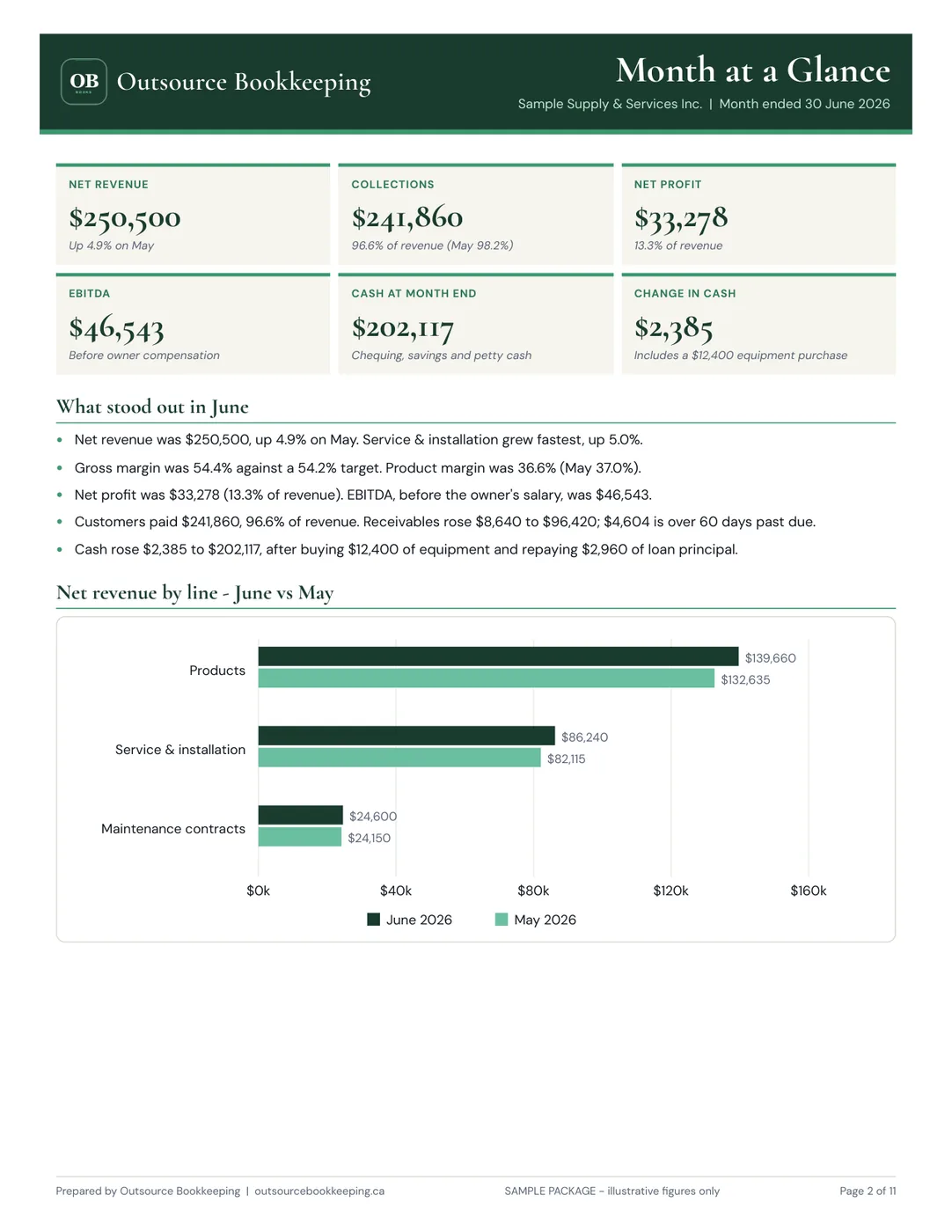
Need professional bookkeeping?
Outsource Bookkeeping delivers CRA-ready financial reports by the 10th of every month — flat rate, no surprises. See our pricing →
